Why is the Strait of Hormuz so critical to global energy supply?
The sharp rise in oil prices since the outbreak of conflict between the US, Israel and Iran reflects one of the largest supply disruptions the market has faced in decades. The Strait of Hormuz, through which roughly 20% of global oil and liquefied natural gas normally transits, has become effectively closed due to mounting attacks and threats on commercial shipping1. This chokepoint has historically been viewed as vulnerable, but the scale of disruption in this episode is unprecedented, the flow of crude through the strait has fallen by at least 10 million barrels per day, more than twice the volume of Russian crude initially considered at risk during the early phase of the Ukraine war.
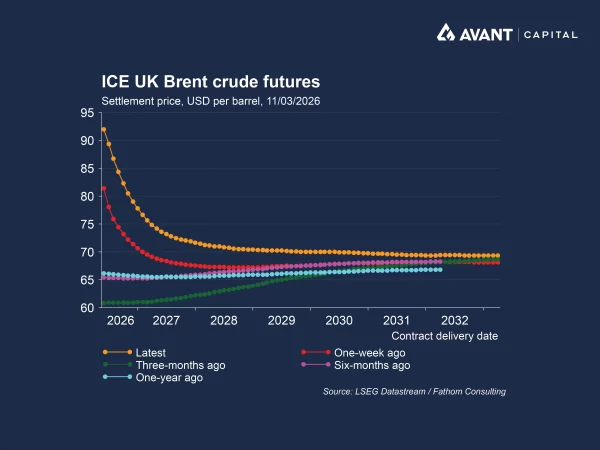
Although President Trump has repeatedly signalled that the war may end “very soon,” the reality is more complex. Even if the US halts its attacks, Iran’s strategic leverage over the strait means it may continue to impede shipping. Iran has publicly stated it would not allow the export of “a single litre” of oil from the region if attacks continue. This underlines the risk that de‑escalation may be out of Washington’s hands, with market normalisation dependent on decisions made in Tehran as much as in Washington.
Shipping insurers have become another critical bottleneck. War‑risk policies are predominantly underwritten in London, not the US, and despite the US proposing a $US20 billion reinsurance backstop, shipowners remain hesitant, and more than 1,000 vessels remain unwilling to attempt the transit2. Insurance is available on paper, but safety concerns for crews, not premiums, have become the main deterrent. Without both physical and perceived security, a meaningful restoration of oil flows through the strait could remain elusive.
How do higher oil prices feed into inflation and interest rates?
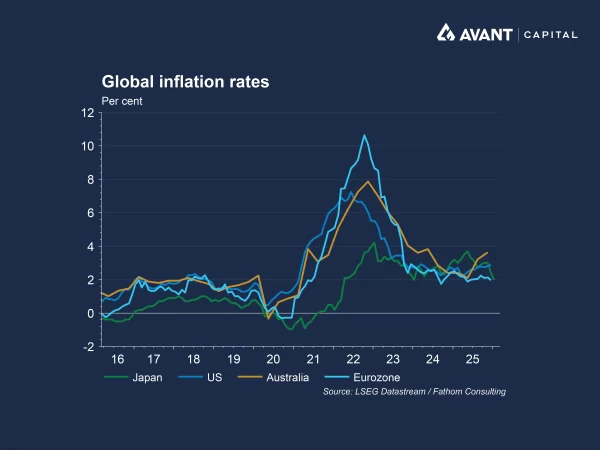
In the United States, the concern is that the sharp rise in crude prices will push inflation higher. Brent crude has climbed about 25% since the conflict began, driving US petrol prices higher for 11 consecutive days, and the US Energy Department expects pump prices to remain elevated well into next year3. This new price shock adds to inflation pressures that were already building, with core producer price inflation rising to 3.6% before the conflict, prompting investors to scale back expectations of near‑term Federal Reserve rate cuts as higher energy costs threaten to slow or even reverse the disinflation trend. Australia faces a similarly delicate backdrop: inflation remains above the RBA’s 2–3% target band, and rising fuel prices risk slowing the return of headline inflation toward target, potentially forcing the central bank to maintain tighter policy for longer as global energy markets remain volatile.
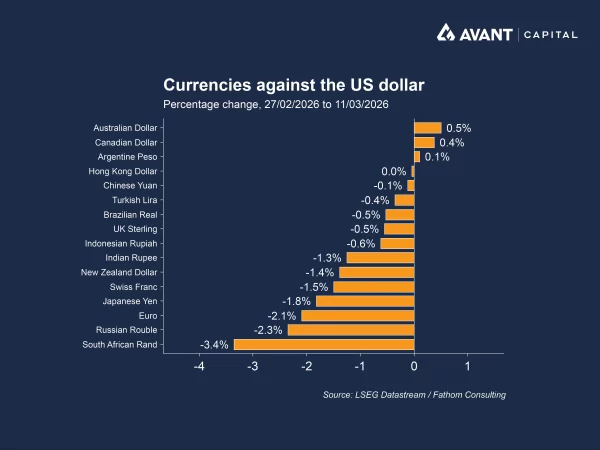
At the same time, the US dollar has strengthened against major currencies as investors seek safety amid heightened geopolitical risk, amplifying the global transmission of tighter financial conditions. The stronger greenback also adds pressure to emerging markets reliant on dollar‑denominated imports, potentially intensifying global inflationary headwinds.
What does this mean for large oil importers?
The effects of higher oil prices and disrupted flows through the Strait of Hormuz are felt most acutely in economies heavily dependent on imported crude, particularly in Asia. Japan, which sources around 95% of its crude from the Middle East, is among the most exposed. In response, Tokyo moved quickly to “act first” by drawing down 15 days of private‑sector oil stocks and a month’s worth of state reserves, even before the IEA’s coordinated emergency release, underscoring the urgency of stabilising domestic supply and curbing stagflation risks.
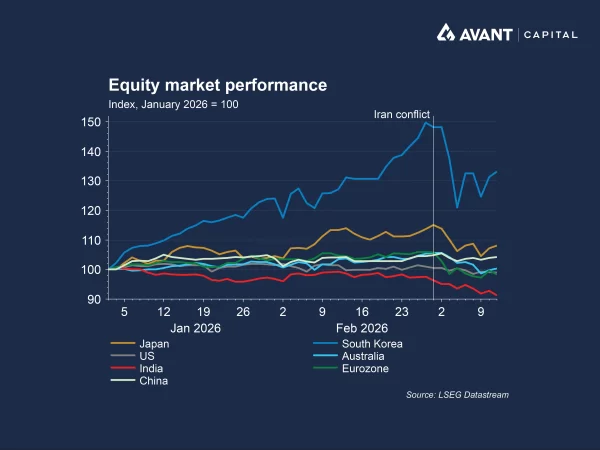
South Korea faces a similarly sharp vulnerability; it imports about 1 billion barrels of oil annually, meaning a $10 rise in global crude prices adds roughly $10 billion to its import bill4. The financial strain has been reflected in local markets, with the Kospi index plunging 7% and then 12% immediately after the Iran strikes before rebounding amid extreme volatility.
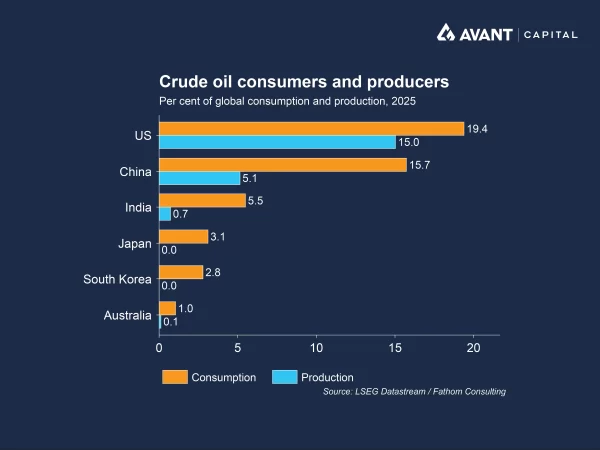
China and India also carry substantial exposure. Together with Japan and South Korea, they receive nearly 70% of Middle Eastern crude flows through the Strait of Hormuz, and even China, despite diversification efforts, still relies on the Gulf for almost half its crude imports. Governments across Asia have already begun restricting exports of refined fuels to safeguard domestic supply, tightening global product markets further.
Europe, too, remains highly vulnerable as one of the world’s largest oil‑importing regions. Having already lost access to Russian pipeline gas after the invasion of Ukraine, the continent now confronts the prospect of a renewed energy squeeze just as it has been adjusting to a more precarious supply landscape.
What can the IEA and global producers do to stabilise the market?
With physical flows severely disrupted, the International Energy Agency has launched the largest strategic reserve release in its history, 400 million barrels, more than double the size of its 2022 release after the Ukraine invasion. This action aims to offset lost supply, which currently exceeds 10 million barrels per day because of the strait closure. However, even this unprecedented move can only provide temporary relief; sustained normalisation requires a reopening of the strait.
Meanwhile, major producers outside the Gulf are adjusting. Saudi Aramco is boosting exports from its Red Sea facilities, enabling about 5 million barrels per day to bypass the strait entirely5. Yet even these diversions cannot fully compensate for the volumes trapped behind the strait.
The global impact of high oil prices will depend largely on how long disruptions persist and how quickly markets can adapt. Ultimately, the trajectory of global markets hinges on the geopolitical decisions yet to unfold and, critically, on whether the Strait of Hormuz safely reopens.
References
- Financial Times, “IEA releases record oil reserves to counter Iran war energy shock,” 12 March 2026
- The Wall Street Journal, “US plan to unblock Strait of Hormuz collides with realities of global insurance,” 11 March 2026
- Financial Times, “US inflation holds steady at 2.4% in February,” 11 March 2026
- Financial Times, “Oil fears hit Asian stocks harder than profits,” 11 March 2026
- Financial Times, “Saudi Aramco warns of ‘catastrophic consequences’ if Iran war drags on,” 10 March 2026