Why did artificial intelligence (AI) become an election issue?
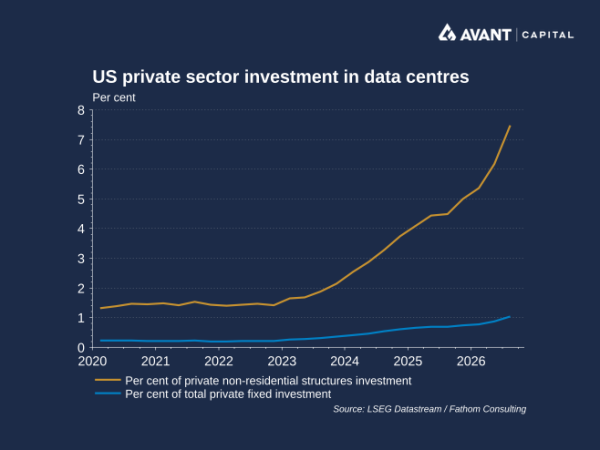
The US midterm elections were not formally a referendum on artificial intelligence. In practice, however, voters delivered a forceful verdict on the physical infrastructure supporting it. Candidates promising tighter controls on data centres won important races, while numerous communities backed measures to pause, restrict or prohibit new developments. Concerns about electricity prices, water consumption, environmental effects and the limited number of permanent jobs created by data centres turned a technology debate into a local political issue. Fifty-six per cent of voters surveyed nationally considered data centres a crucial or major factor in their congressional choices, according to a national survey conducted by polling firm SSRS1.
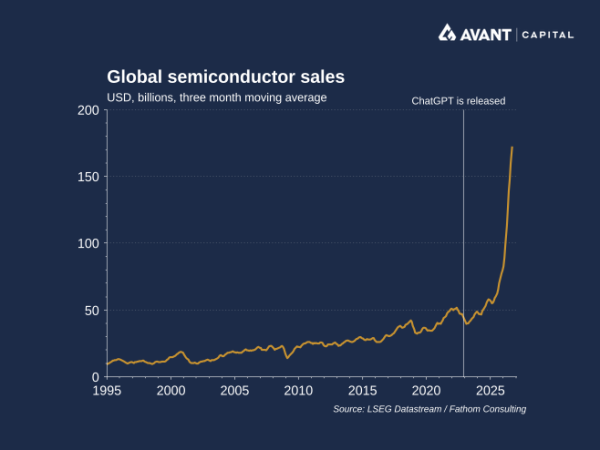
The outcome matters because the AI race increasingly depends on access to land, electricity, water, computing capacity and regulatory approval. Training and operating advanced AI models requires enormous clusters of semiconductors housed in power-intensive facilities. If those facilities take longer to approve or build, the expansion of available computing power also slows. The election has therefore introduced political risk into an investment cycle previously shaped mainly by technological demand, financing conditions and access to advanced chips.
Where could the greatest disruption occur?
The most immediate effects are likely to emerge at state and local level rather than in Washington. Although the Democrats gained control of Congress, presidential veto power could limit major federal legislation. Governors, legislatures, utility regulators and municipalities have more direct influence over planning approvals, tax incentives, water access and grid connections.
Texas is the most important test. The state is home to roughly a quarter of planned US data-centre development2, while Texas, Georgia and Ohio together represent more than 40% of planned national capacity, according to investment bank Evercore ISI. An estimated 18 gigawatts of planned Texas capacity for 2028 could be affected, while 41% of America’s planned capacity sits in states where incoming governors favour a pause, according to market intelligence firm Cleanview.
New rules could include temporary moratoriums, stricter environmental and utility requirements, the withdrawal of tax concessions and greater authority for local governments to reject projects. Such measures would not necessarily stop the build-out, but they could extend development timelines and make future projects more expensive or uncertain.
Why did markets react so violently?
The election result challenged one of the market’s most important assumptions: that spending on AI infrastructure would continue rising rapidly for years. The initial repricing was severe. The Nasdaq 100 and S&P 500 fell sharply and around $US3.2 trillion was erased from the broad S&P 1500 Composite in one session3. Nvidia fell 9.3%, while several chip and memory companies recorded even larger declines.
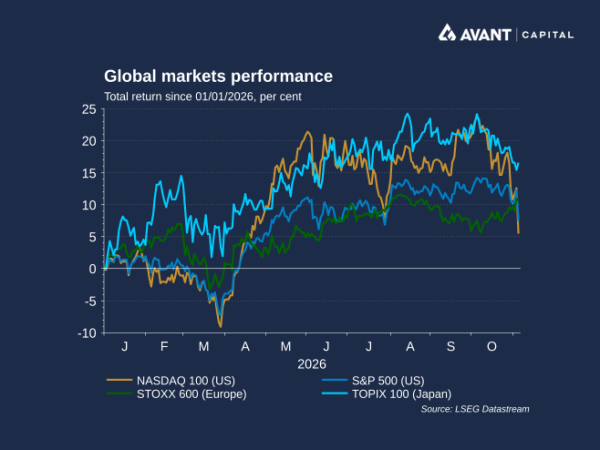
The magnitude of the fall reflected more than politics. AI-related shares had become heavily owned, market indices were increasingly concentrated and leveraged investors were exposed to a continuation of the spending cycle. Uncertainty over construction therefore triggered profit-taking, reductions in leveraged positions and mechanical selling. The election was a catalyst for vulnerabilities that were already present, including rising borrowing costs, heavy capital expenditure and doubts about how quickly AI investment will generate adequate returns.
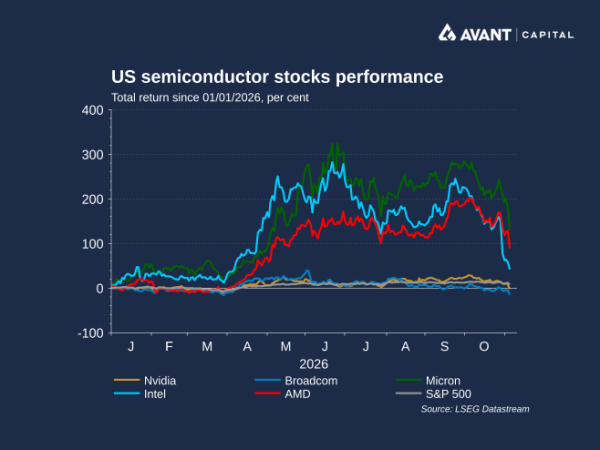
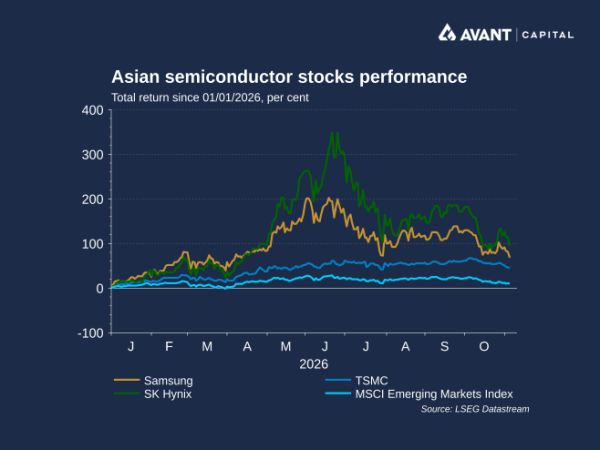
The effects also travelled beyond the US. South Korea’s Kospi fell 4.8% and Taiwan’s benchmark index declined 2.6% as investors reassessed demand for memory chips and other components linked to US data-centre spending4.
Who could be most exposed to a slowdown?
The consequences are unlikely to be evenly distributed. Newer “neocloud” providers and speculative developers depend on obtaining financing, power and permits for capacity that has not yet been completed. Delays can push revenue further into the future while interest and development expenses continue accumulating. Chipmakers, memory producers, power suppliers and construction contractors could also face weaker orders if projects are postponed or reduced in size.
By contrast, established hyperscalers such as Microsoft, Amazon, Alphabet and Meta already control substantial computing infrastructure and have stronger balance sheets. A slower construction cycle could increase the scarcity value of operating data centres, reduce competition for labour and equipment, and ease pressure on capital expenditure. Existing facilities with secured power may become more valuable if new construction is constrained.
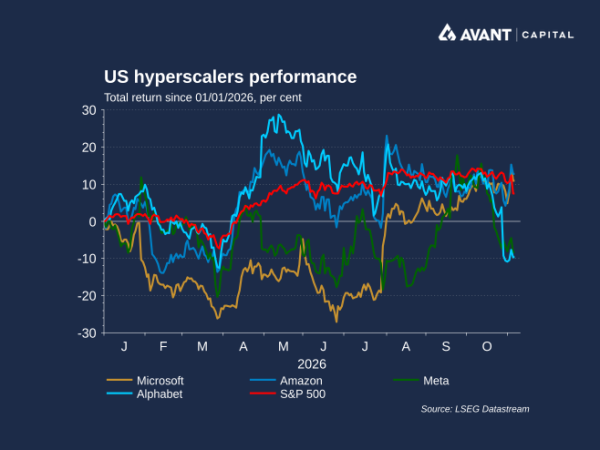
This distinction suggests that the political shift may produce a shakeout rather than an end to AI investment. Companies with approved projects, secure electricity supply and strong credit profiles may gain an advantage over businesses whose valuations depend on continuous construction and readily available debt.
Could a slowdown ultimately strengthen the sector?
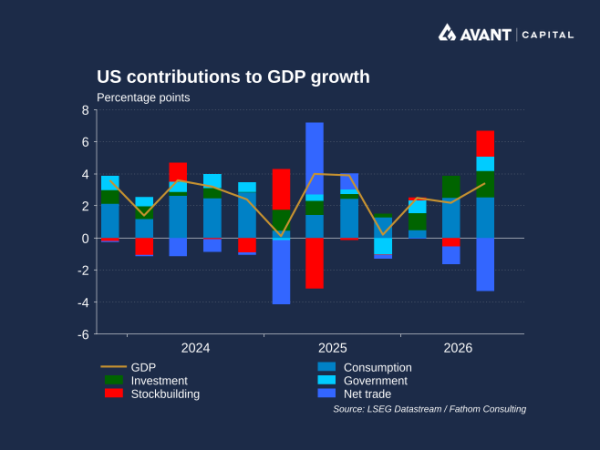
A pause could have benefits. Planned spending has reached a scale at which financing and returns are becoming as important as technological progress. Research estimates approximately $US10 trillion of cumulative data-centre investment over the seven years to 2032, equivalent to around 3.6% of US GDP over that period5. Delaying weaker projects could reduce overbuilding and limit investment in equipment that may become obsolete faster than expected.
It could also force technology companies to improve community engagement. Industry leaders have acknowledged that local residents need clearer evidence of benefits, including infrastructure investment, ratepayer protection, employment and tax revenue. More than 200 companies have signed a non-binding pledge intended to prevent data-centre electricity costs from being passed to consumers6.
What comes next for the AI infrastructure boom?
The most likely outcome is not a collapse in AI development, but a slower, more selective and more politically accountable build-out. Existing projects may continue, while proposed facilities face closer scrutiny over power, water, public subsidies and local benefits. Some development may shift to other US states or overseas, although moving infrastructure introduces its own regulatory, security and supply-chain complications.
The midterms have changed the central question surrounding AI. It is no longer simply whether companies can build enough computing capacity. It is whether they can demonstrate that the build-out serves the communities being asked to host and support it. The AI infrastructure boom may continue, but its next phase is likely to be shaped as much by political consent as by technological ambition.
References
- The Wall Street Journal, “The election day revolt that threatens America’s AI boom,” 4 November 2026
- Financial Times, “Will Democrats stall the AI boom?” 6 November 2026
- Financial Times, “Wall Street sheds $3.2tn as Democratic midterm sweep triggers brutal AI rout,” 6 November 2026
- Financial Times, “Asian tech stocks slide on post-midterm AI fears,” 5 November 2026
- Financial Times, “Morning in America, twilight in the markets,” 5 November 2026
- Financial Times, “AI backlash threatens trillion-dollar data centre boom, say tech leaders,” 6 November 2026