
Why has America’s debt burden become harder to ignore?
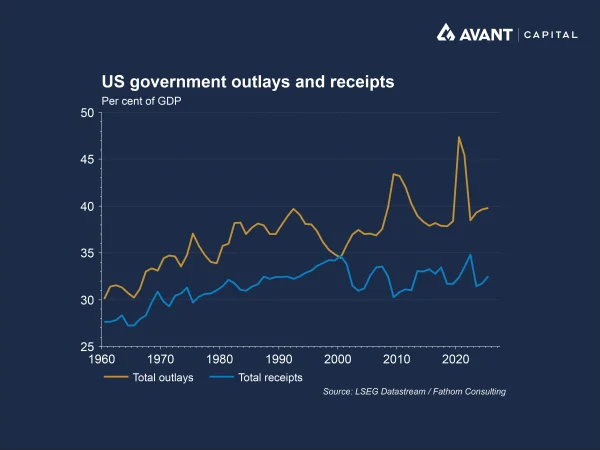
Warnings about US government debt are hardly new. What has changed is the price of carrying it. The US debt stock recently reached a record $US40 trillion, while persistent fiscal deficits have coincided with borrowing costs near their highest levels in years1. Interest payments are therefore absorbing an increasing share of public revenue and limiting the government’s room to respond to future economic, geopolitical or financial shocks.
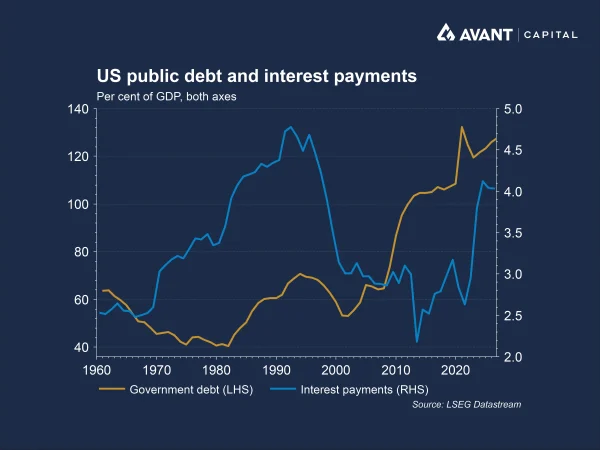
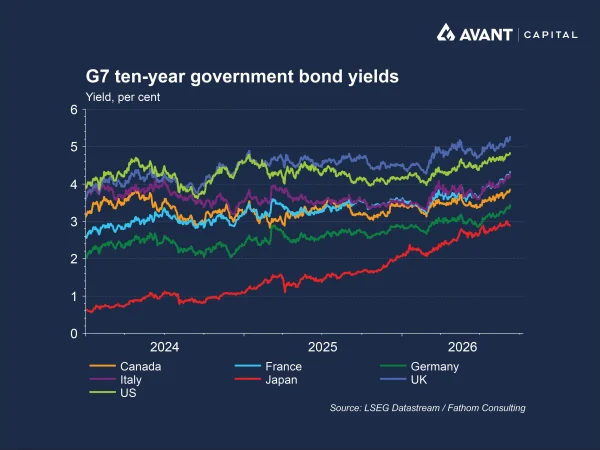
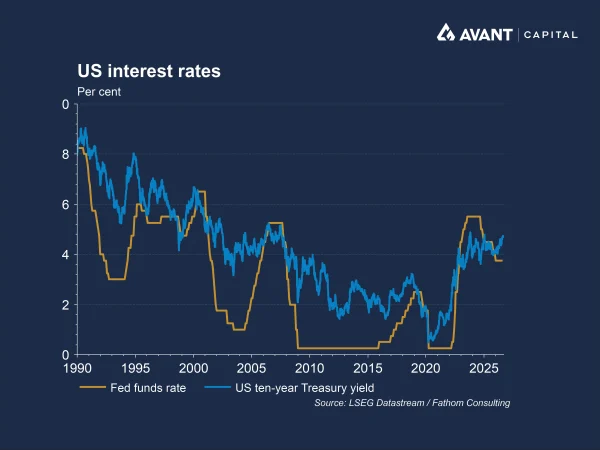
For decades, low inflation, strong demand for dollar assets and central-bank bond purchases allowed governments to increase debt without immediately confronting its full cost. That environment has reversed. The average benchmark 10-year yield across the G7 has reached 4 per cent for the first time since 2008, while annual OECD government interest expenditure has exceeded $US2 trillion. In the US, interest payments have more than doubled over five years to around 4 per cent of GDP2.
The difficulty is that today’s higher yields feed gradually into tomorrow’s budget. As older, cheaper securities mature, they must be refinanced at prevailing rates. Higher servicing costs then enlarge future deficits, requiring still more issuance. This does not guarantee a debt crisis, but it creates the conditions for an adverse feedback loop in which fiscal anxiety raises yields and higher yields aggravate fiscal anxiety.
What is driving US bond yields higher?
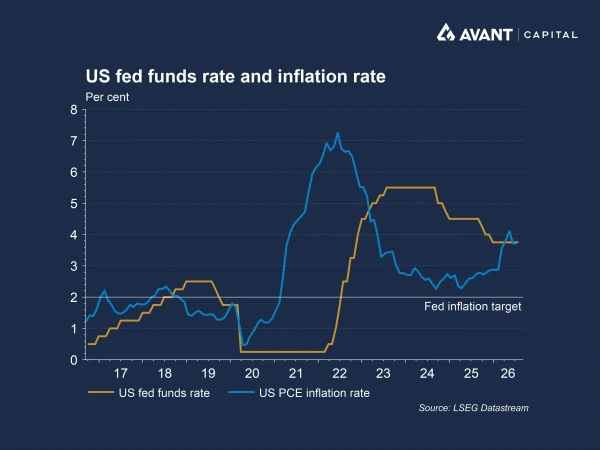
No single explanation accounts for the rise. Inflation remains central, particularly as the ongoing US-Iran conflict and fighting over control of the Strait of Hormuz have pushed oil prices above $100 a barrel and intensified concerns about global energy supplies. Higher energy costs can lift inflation expectations, reduce the scope for monetary easing and lead investors to demand higher yields on long-dated bonds to compensate for the risk that inflation will erode the real value of their fixed future payments.
Supply is another part of the story. Governments are issuing record quantities of debt at the same time that technology companies are raising capital for artificial-intelligence infrastructure. The public and private sectors are consequently competing for the same global savings. Investors may still be willing to finance both, but only at yields that adequately compensate them for inflation and policy uncertainty.
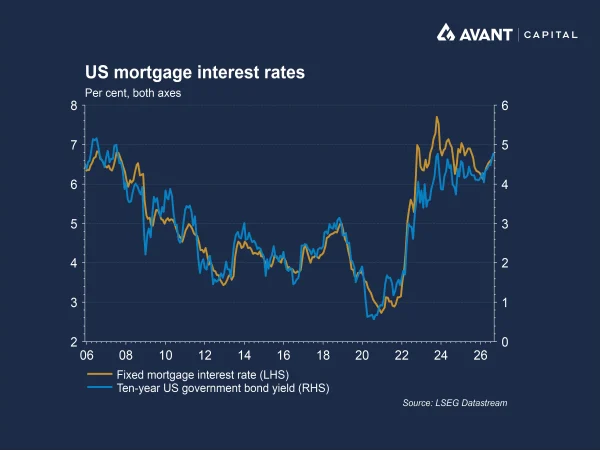
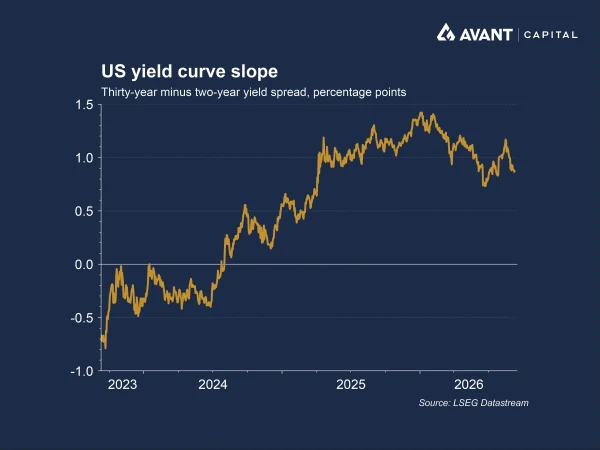
The benchmark 10-year Treasury yield recently approached 4.8 per cent, while 30-year borrowing costs reached levels not seen for almost two decades3. Elevated Treasury yields have consequences far beyond the government bond market because they influence mortgage rates, corporate financing costs and asset valuations around the world. They also offer investors a relatively safe return, raising the hurdle that equities and other riskier assets must clear to attract capital.
Can Treasury buybacks overcome economic fundamentals?
In September 2026, the US Treasury responded to a sell-off in long-dated government bonds and the accompanying rise in US borrowing costs by expanding purchases of older long-dated securities. Its announced $US6 billion operation was larger than the buyback programme’s earlier scale but smaller than some investors had anticipated4. Instead of falling, the 10-year yield initially rose to almost 4.86 per cent as markets expressed disappointment. A subsequent $US39 billion auction nevertheless attracted solid demand, showing that buyers had not abandoned Treasuries at the higher yields.
Buybacks can improve liquidity by exchanging less frequently traded bonds for newer, more liquid securities. They can also remove some duration from the market and temporarily support long-dated bond prices. What they cannot do is reduce the underlying stock of government obligations unless accompanied by a sustained improvement in the fiscal balance.
That distinction explains the market’s scepticism. If intervention is perceived as an effort to prevent yields from fully reflecting inflation and growing debt supply, it may weaken confidence in the Treasury market’s price-discovery function. Investors could respond by demanding a higher term premium, meaning greater compensation for the inflation, interest-rate and fiscal risks involved in holding long-dated government bonds. Measures intended to suppress yields may therefore prove counterproductive if they increase the risk premium embedded in those yields.
Why does intervention in the yen matter to Treasuries?
Washington’s unusual joint intervention with Tokyo connects the currency and bond stories. In July, the US and Japan acted together to support the yen, marking the first outright joint purchases of the currency in nearly 30 years. The New York Federal Reserve sold euros to buy yen on behalf of the Treasury, while estimated Japanese intervention around the same period reached ¥8.45 trillion5.
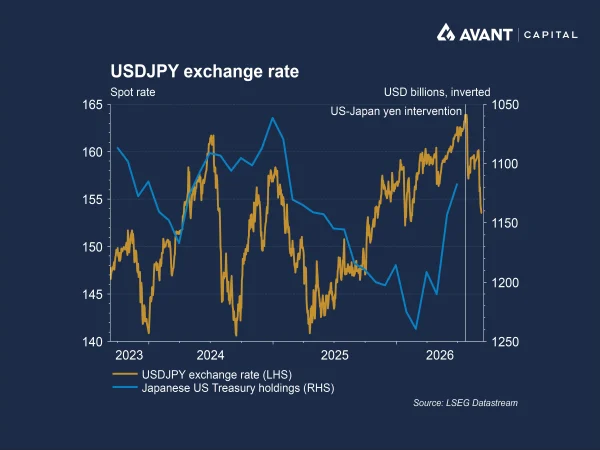
Japan has traditionally been one of the most important overseas holders of US government debt, with Treasury holdings of roughly $US1 trillion6. A severely weak yen leaves Japanese authorities with two broad responses: raise domestic interest rates more aggressively or sell foreign assets to obtain currency for intervention. Either route could reduce Japanese demand for Treasuries or place additional securities into the market.
US support for the yen can therefore be understood partly as protection for the Treasury market. Facilities allowing foreign authorities to obtain dollar liquidity against Treasury collateral, rather than selling those securities outright, serve a similar purpose. Currency intervention in this context is not an isolated foreign-exchange event. It forms part of a broader attempt to preserve stable demand for American debt.
What are the wider market consequences?
The effects are already visible in corporate credit. The additional yield demanded from the lowest-rated US companies has risen to 10.53 percentage points, compared with 8.08 percentage points a year earlier7.
Traditional portfolio relationships have also become less dependable. Since 2021, inflation has frequently caused bonds and equities to decline together, weakening the diversification benefits historically associated with a conventional stock-and-bond portfolio. At the same time, concerns about fiscal discipline and policy intervention have contributed to demand for alternative stores of value and renewed debate about confidence in the dollar.
What will ultimately determine whether intervention succeeds?
Buybacks, liquidity facilities and co-ordinated currency operations can reduce disorder, influence positioning and buy policymakers time. They cannot permanently repeal the relationship between debt, inflation and interest costs. Lasting relief would require some combination of stronger productivity growth, lower inflation and a credible narrowing of the fiscal deficit.
The central issue is therefore not whether Washington has enough tools to move markets over a day or a week. It is whether those tools can remain credible when used against persistent economic fundamentals. The Treasury may be able to influence where pressure appears, but unless the debt trajectory changes, it cannot ensure that the pressure disappears.
References
- Financial Times, “The world’s $2tn interest bill,” 8 September 2026
- Financial Times, “Why America’s debt binge is starting to matter,” 7 September 2026
- The Wall Street Journal, “Bessent’s latest buyback move leaves investors wanting more,” 9 September 2026
- Financial Times, “Treasury yields jump as Bessent’s $6bn buyback plan disappoints investors,” 10 September 2026
- Financial Times, “US Treasury undertakes historic intervention in yen market,” 2026
- Financial Times, “Yen intervention = US self-preservation,” 4 August 2026
- Financial Times, “Treasury sell-off piles pressure on weakest US borrowers,” 5 September 2026