Artificial intelligence is driving one of the largest infrastructure buildouts in modern economic history. As technology companies race to develop increasingly powerful AI models and deploy them at scale, a vast network of data centres, power infrastructure, fibre connections, semiconductors and supporting industries is being built to support the digital economy.
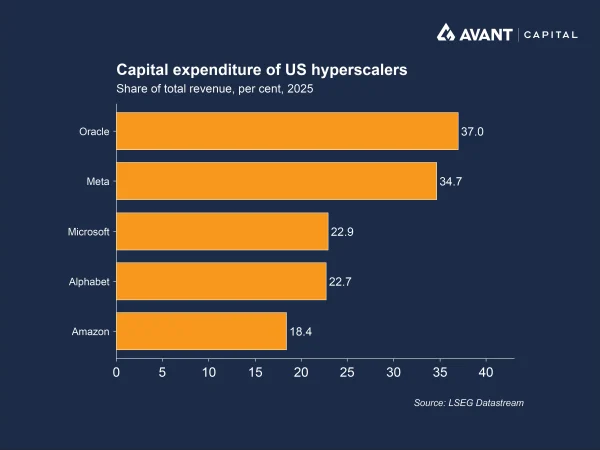
The scale of investment is extraordinary. The world’s largest technology companies are collectively committing hundreds of billions of dollars annually to AI infrastructure. Some estimates suggest annual spending by major hyperscalers such as Microsoft, Amazon, Alphabet, Meta and Oracle is approaching $US750 billion, while broader technology-sector infrastructure spending is moving beyond the $US1 trillion mark1. This investment wave is increasingly being compared with historical infrastructure booms such as the railway expansion, electricity networks and major resource development cycles.
How are data centres becoming the foundations of the AI economy?
Every AI application ultimately depends on computing power. Training and operating large AI models requires immense amounts of processing capacity, data storage and network connectivity. Data centres have therefore become the physical backbone of the AI ecosystem.
The rapid growth in AI usage has triggered a surge in demand for specialised facilities capable of housing high-performance computing equipment. Across many developed economies, data centre development pipelines have expanded dramatically as operators seek to increase capacity for cloud computing, AI training and inference workloads.
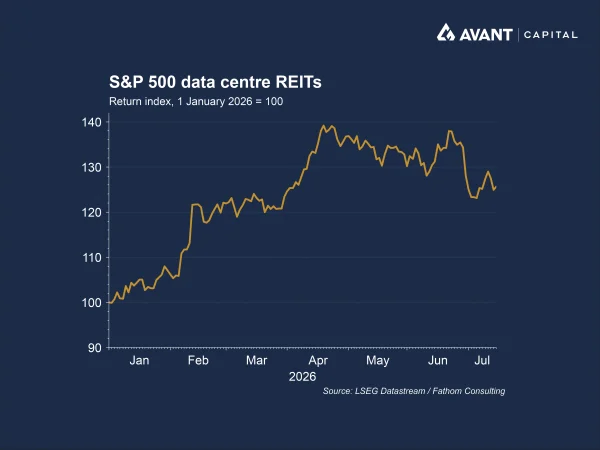
This expansion is not confined to technology companies. Telecommunications providers, infrastructure developers, equipment manufacturers, engineering contractors and construction firms are all participating in the buildout. In many ways, data centres have evolved into critical infrastructure assets, similar to ports, roads and energy networks in earlier economic cycles. This growing strategic importance has also been reflected in markets, with data centre real estate investment trusts (REITs) delivering strong returns in 2026 as investors have sought exposure to accelerating AI-driven demand for computing infrastructure.
What role is big tech capital expenditure playing?
The defining characteristic of the current AI cycle is the sheer scale of capital expenditure.
In previous decades, many large technology businesses operated relatively asset-light models. Today, however, hyperscalers, large cloud computing providers that operate vast global networks of data centres and digital infrastructure, are becoming infrastructure owners on an enormous scale. Massive investments are flowing into data centres, semiconductor purchases, networking equipment, cooling systems and electricity infrastructure.
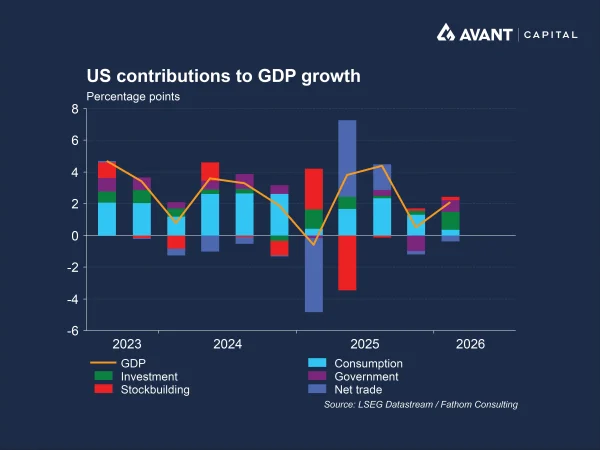
In some cases, data centre spending is beginning to dominate broader construction activity. Recent reporting from the United States showed data centre construction rising strongly even as spending on factories, warehouses and other industrial projects softened amid higher costs and interest rates2. This highlights how AI-related infrastructure has become one of the primary drivers of investment activity in parts of the global economy.
The spending surge has also altered corporate financing behaviour. Some of the world’s largest technology firms have increasingly tapped debt markets to fund capital expenditure as investment requirements continue to grow. Analysts note that hyperscaler borrowing has expanded rapidly as companies seek to finance long-term AI infrastructure development.
Why is the AI buildout creating demand for energy and resources?
AI is fundamentally an energy-intensive technology.
Modern data centres consume vast amounts of electricity, while advanced AI systems require increasingly powerful processors that generate significant heat and require sophisticated cooling systems. As a result, demand is growing not only for data centre buildings but also for electricity generation, transmission infrastructure and critical equipment.
This dynamic is creating substantial flow-on effects throughout supply chains. Electrical systems often represent one of the largest cost components of data centre developments, driving demand for transformers, switchgear, cabling and other specialised equipment. In several markets, shortages of electrical infrastructure are emerging as development pipelines expand. Contractors have reported long lead times for transformers and other essential equipment as both renewable energy projects and data centres compete for limited supply.
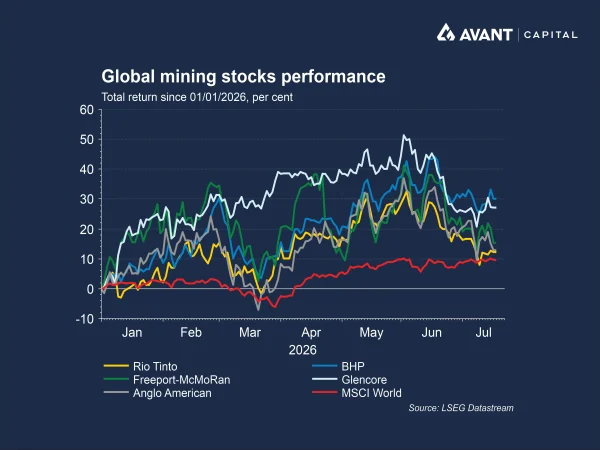
The trend also has implications for mining and commodities. Copper, steel and other industrial materials remain critical inputs into the construction of energy networks, transmission infrastructure and large-scale digital facilities. While AI is often viewed through a software lens, its physical footprint relies heavily on resources traditionally associated with industrial and infrastructure development.
How are governments responding to the data centre boom?
As data centre development accelerates, policymakers are increasingly focused on balancing economic opportunity with energy security, environmental outcomes and community expectations.
A growing theme globally is the expectation that future AI infrastructure will contribute directly to the energy systems they depend upon. Emerging policy frameworks increasingly emphasise renewable energy integration, power efficiency, water management and grid support requirements.
Many governments also see AI infrastructure as strategically important, given its links to economic competitiveness, cybersecurity and technological sovereignty. At the same time, local communities are raising concerns about energy consumption, water usage, land requirements and noise impacts. As a result, obtaining a social licence to operate is becoming an important consideration for developers, much as it has been for large-scale resource projects.
Where are the risks in the AI infrastructure boom?
While enthusiasm surrounding AI remains strong, questions are emerging about the sustainability of current investment levels.
Several market observers have highlighted growing scrutiny of whether returns from AI adoption will ultimately justify the enormous capital commitments being made today. Surveys suggest many businesses remain in the early stages of integrating AI into operations and have yet to realise substantial enterprise-wide productivity gains3. While individual use cases can improve efficiency, large-scale implementation often requires extensive changes to workflows, operating models and organisational structures.
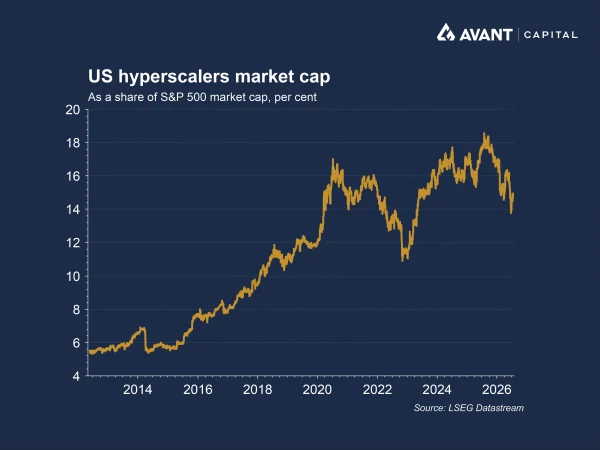
Financial regulators and market analysts have also noted rising valuations across AI-related sectors and increasing dependence on continued investment momentum. This is particularly important given that hyperscalers and other AI-linked technology companies now account for a substantial share of the S&P 500’s market capitalisation and have been major drivers of equity market returns in recent years. As a result, expectations for future earnings growth and returns on AI investments remain exceptionally high. Concerns have been raised that productivity gains and commercial returns may need to accelerate significantly to justify the scale of infrastructure spending currently under way and support prevailing valuations.
What could the next decade look like?
Despite these challenges, the long-term direction appears clear. AI adoption continues to expand, computing requirements are increasing and demand for digital infrastructure is growing across industries.
Much like previous infrastructure revolutions, the benefits are likely to extend well beyond the headline participants. Energy networks, telecommunications infrastructure, construction, engineering services, manufacturing supply chains and resource producers may all play important supporting roles in the broader ecosystem.
The key takeaway is that AI is no longer just a technology trend. It has become a physical infrastructure story. The data centres, transmission networks, energy systems and supply chains being developed today could shape economic activity for years to come, creating what may ultimately be remembered as one of the most significant capital investment cycles of the modern era.
References
- The Australian, “Australia’s new mining super cycle: AI sparks historic data centre spending spree,” 16 July 2026
- The Wall Street Journal, “AI data-centre construction is booming – not much else is,” 14 July 2026
- The Australian Financial Review, “AI’s profitless boom is becoming a problem,” 29 June 2026