
For much of the period following the Global Financial Crisis, investors became accustomed to exceptionally low interest rates and subdued government bond yields. Central banks purchased trillions of dollars of bonds, helping keep long-term borrowing costs low.
That backdrop has shifted in recent months. Across major economies, long-dated government bond yields have risen sharply, with several reaching their highest levels in years or even decades. The yield on the US 30-year Treasury recently climbed above 5.3%, its highest level since 2007, while long-term bond yields in France, the United Kingdom and Japan have also risen to levels not seen since the global financial crisis era or earlier1.
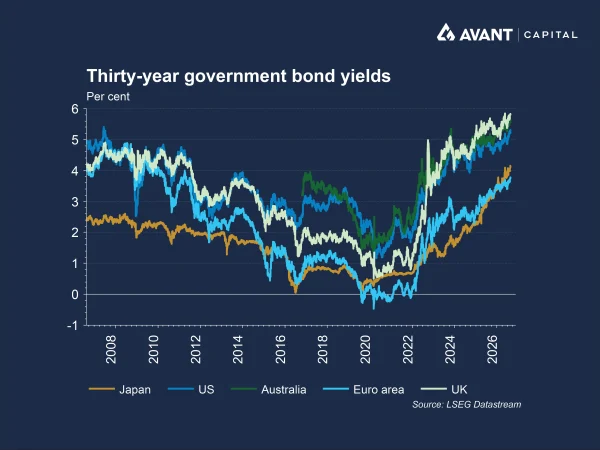
The move has been global in nature, suggesting that investors are reacting to a combination of structural and cyclical forces rather than any single country’s problems.
Why are investors demanding higher yields from governments?
Perhaps the most important driver is the growing concern over government debt burdens.
The US national debt has now reached $US40 trillion after rising by roughly $US3 trillion in just the past year, one of the fastest rates of increase outside the pandemic period. Debt held by the public, a key metric monitored by markets that excludes intragovernmental holdings, now exceeds $US32 trillion, roughly equivalent to the size of the entire US economy2. Investors are increasingly questioning whether governments have the political will to meaningfully reduce deficits and stabilise debt levels.
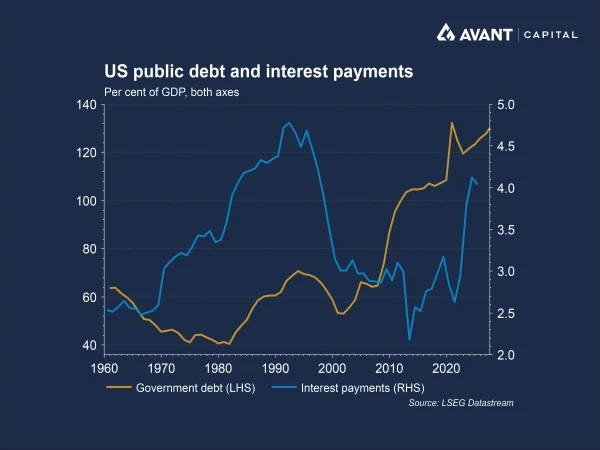
The concern is not confined to the United States. Many developed economies continue to run substantial budget deficits while simultaneously facing rising defence spending requirements, ageing populations and pressure to support economic growth. As governments issue more debt to fund these commitments, investors are demanding higher compensation in the form of higher yields.
Some market observers have described this as the return of the “bond vigilantes”, where investors effectively force governments to pay higher borrowing costs when fiscal discipline appears lacking3.
How is inflation uncertainty contributing to higher yields?
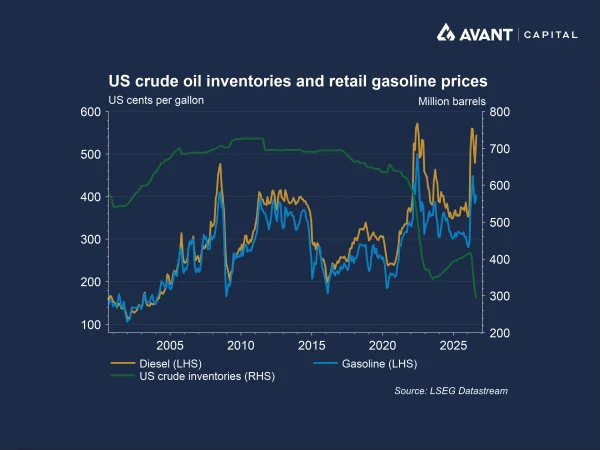
Another major factor is uncertainty surrounding inflation. The conflict involving Iran continues to create uncertainty over global energy markets, with Brent crude oil recently trading above $US90 per barrel4. Higher energy prices raise concerns that inflation could remain above central bank targets for longer than previously expected.
While US inflation has moderated from its recent highs, it remains above the Federal Reserve’s target. Moreover, Federal Reserve meeting minutes show that many policymakers remain concerned that years of above-target inflation could become embedded in consumer and business expectations, making future inflation more difficult to control5.
Importantly, the issue is not simply current inflation readings. Bond markets are pricing uncertainty around where inflation will settle over the coming decade. If investors believe inflation risks remain elevated, they will naturally demand higher yields before committing funds for 10, 20 or 30 years.
How much does Federal Reserve uncertainty matter?
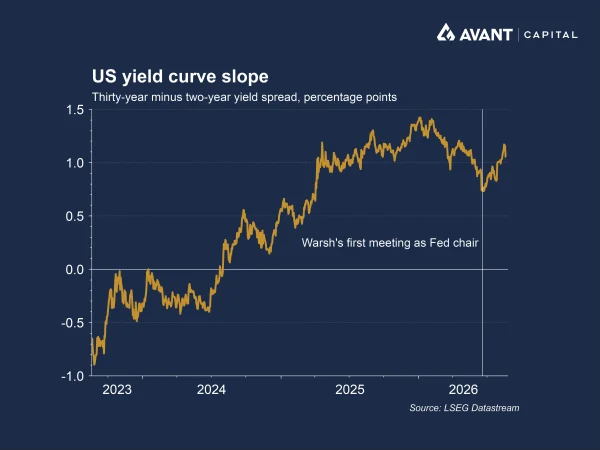
Adding to the uncertainty is the leadership of Federal Reserve Chair Kevin Warsh.
Unlike previous Federal Reserve leadership teams that often provided extensive forward guidance, Warsh has deliberately offered limited guidance on the future path of interest rates. While he has pledged to tackle inflation, markets remain uncertain about his policy approach and whether it will be sufficient to return inflation to target.
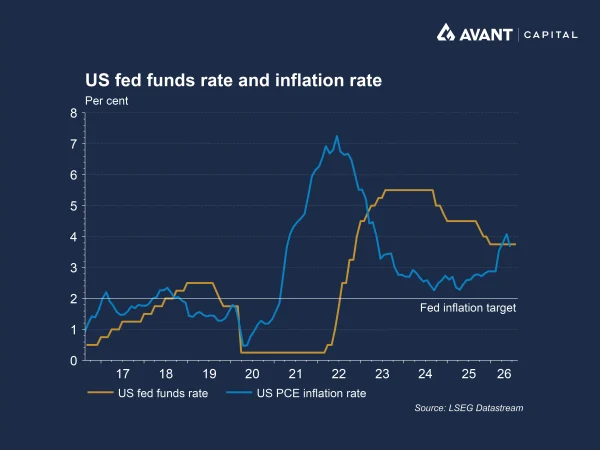
This lack of guidance forces investors to price additional uncertainty into bond markets. Markets are no longer being “hand-fed” the central bank’s likely policy path and must instead account for a broader range of possible outcomes. The result is a higher risk premium for long-dated government bonds.
How is the AI boom affecting bond markets?
A less obvious but increasingly important influence has been the explosion in AI-related borrowing.
The world’s largest technology companies, often referred to as “hyperscalers”, are investing unprecedented amounts of capital into artificial intelligence infrastructure. Hyperscalers are large cloud-computing and digital infrastructure companies such as Alphabet, Amazon, Microsoft and Meta that operate enormous data centre and cloud computing networks.
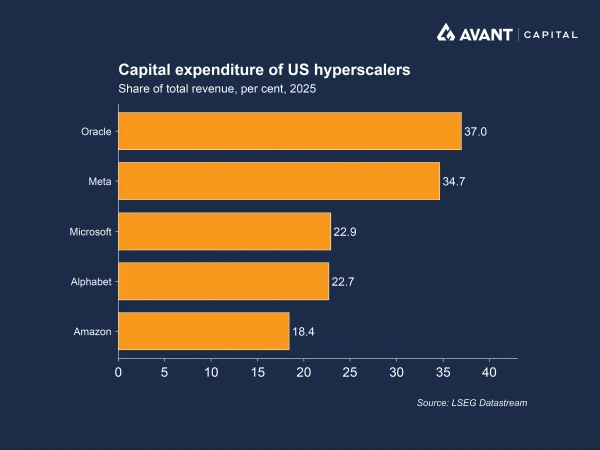
Historically, many of these companies funded investment largely through internal cash flows. However, the scale of AI spending has become so large that they are increasingly turning to bond markets for financing. Hyperscalers have already issued more than $US220 billion of bonds in 2026 and some estimates suggest issuance could accelerate further in coming years6. The trend has become increasingly global, with Alphabet recently launching its first Australian dollar bond issue, reportedly seeking to raise up to $5 billion as it expands funding sources for AI-related investment7.
This matters because governments and corporations are competing for the same pool of investor capital. When governments are issuing large amounts of debt and technology companies are simultaneously issuing record volumes of bonds to fund AI infrastructure, investors can demand higher yields before absorbing all that supply.
What does this mean for equity markets?
Higher bond yields matter because they represent the foundation of global asset pricing.
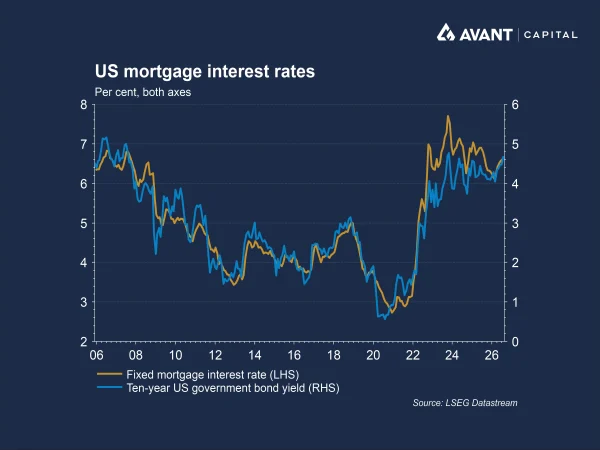
Government bond yields influence mortgage rates, corporate borrowing costs and valuation models across financial markets. When yields rise, the present value of future company earnings falls, which can place pressure on equity valuations, particularly among growth companies whose profits are expected further into the future.
This dynamic has already begun to appear in technology stocks. Recent bond market volatility contributed to weakness across AI-related shares, including semiconductor and memory companies that have been major beneficiaries of the AI investment boom.
More broadly, persistently higher bond yields increase financing costs for businesses and households. Governments must allocate more revenue toward servicing debt, companies face a higher cost of capital when investing, and consumers encounter more expensive mortgages and loans.
What is the bigger picture?
The recent rise in global government bond yields may ultimately represent more than a temporary market adjustment. It could signal a transition away from the ultra-low-rate environment that dominated much of the post-2008 period.
Markets are increasingly confronting a world characterised by larger government deficits, significant geopolitical uncertainty, ongoing inflation risks and enormous capital requirements associated with artificial intelligence infrastructure, defence spending and supply chain reorganisation.
Whether yields continue to rise from here remains uncertain. However, what appears increasingly clear is that investors are demanding greater compensation for lending money over the long term. In that sense, higher bond yields may not simply be a short-term market fluctuation, but a reflection of a changing economic and financial landscape.
References
- Financial Times, “US chip stocks slide as government borrowing costs hit multi-year highs,” 18 August 2026
- Financial Times, “US government debt hits $40tn as borrowing rises at historic rate,” 20 August 2026
- The Australian Financial Review, “Bonds are flashing a warning sign again. It’s time to listen,” 19 August 2026
- Financial Times, “First FT: Global bond sell-off deepens,” 18 August 2026
- Financial Times, “Federal Reserve officials express rising concern over persistently high US inflation,” 20 August 2026
- Financial Times, “AI investment concentration risk is not just in equities,” 30 July 2026
- The Australian Financial Review, “Google prepares $5b Kangaroo bond as AI arms race comes to Australia,” 17 August 2026