
What did reporting season reveal about corporate Australia?
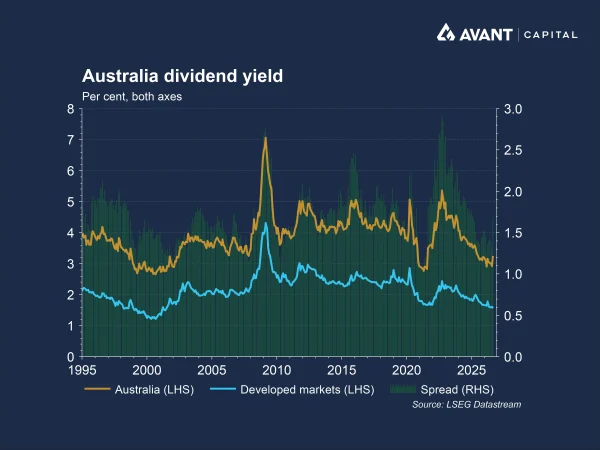
Australian shareholders are preparing to receive a wall of cash. Two-thirds of listed companies increased the quantum of their dividends this reporting season, the highest proportion since 2021, while almost four companies exceeded dividend expectations for every one that missed them1. Dividends and franking credits have long been central to the appeal of Australian equities, but the scale of the latest payouts raises a larger question: are companies rewarding shareholders today at the expense of investing for tomorrow?
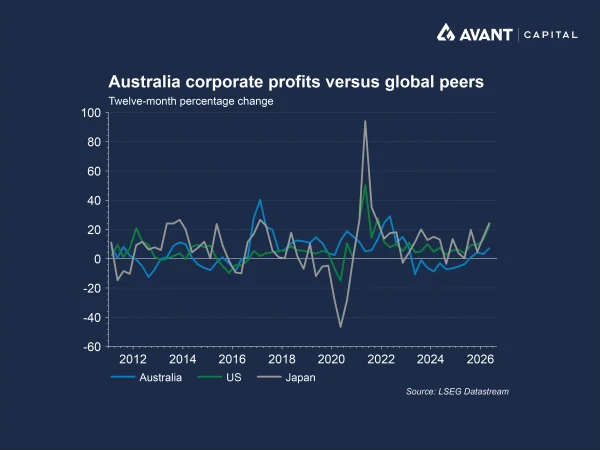
The dividend strength contrasted with a subdued earnings outlook. Early in reporting season, market-level profit growth was about 10%, but only around 5% outside mining and energy2. Forward guidance for the 2027 financial year was weaker than expected, while analysts subsequently cut expected ASX 200 earnings growth for the year from almost 13% two months earlier to 9.3%3. Commodity producers helped dividends beat expectations even as broader earnings forecasts deteriorated.
This matters because the market appeared to reward higher payouts more enthusiastically than stronger earnings guidance. For boards and management teams, that creates an unmistakable signal: returning cash can produce an immediate share-price benefit, while retaining it for investment may invite scepticism, particularly where investors lack confidence in management’s ability to deploy capital successfully.
Why do tax changes strengthen the preference for dividends?
The federal budget’s capital gains tax changes could reinforce this behaviour. From 1 July 2027, the existing 50% CGT discount is due to be replaced by inflation indexation and a minimum 30% tax rate on net capital gains for affected taxpayers4. Franked dividends, meanwhile, retain their existing relative advantage for domestic investors.
The distinction is important. When a company distributes profit, an Australian shareholder receives cash and may also receive franking credits reflecting company tax already paid. When the company retains that profit and invests it successfully, the shareholder generally receives the benefit indirectly through a higher share price and an eventual capital gain. By increasing the effective tax burden on some capital gains relative to franked income, the new system may make a dollar paid out today more attractive than a potentially larger but uncertain gain tomorrow.
The economic issue is not the payment of dividends itself, but whether companies are being encouraged to favour payouts over worthwhile investment. Mature companies with few attractive projects should return surplus capital rather than pursue wasteful acquisitions or low-return expansion. The concern arises when tax and market incentives encourage payouts even where investment in technology, equipment, software, research or expansion could earn an adequate long-term return. Dividends distribute value already created. Reinvestment can create additional value, although it also entails risk.
The Reserve Bank’s internal analysis estimated that the changes could lift the cost of capital for non-financial businesses by between 0.11 and 0.26 percentage points5. It also warned that capital could tilt towards mature, income-producing companies and away from start-ups and businesses whose returns depend more heavily on capital growth. Treasury has taken a less pessimistic view, arguing that individuals own less than 15% of ASX-listed shares and that superannuation funds and foreign investors are largely unaffected.
Could income investing make the ASX less competitive?
Australia already begins from a strong income bias. Between 2003 and 2024, the S&P/ASX 300 delivered an average trailing dividend yield of 4.1%, compared with 1.9% for the S&P 500 and 2.3% globally. Dividends have contributed more than 60% of the ASX 200’s total return over the past decade, whereas American investors have relied much more heavily on capital appreciation. This income-heavy market structure has also coincided with Australian shares underperforming global peers.
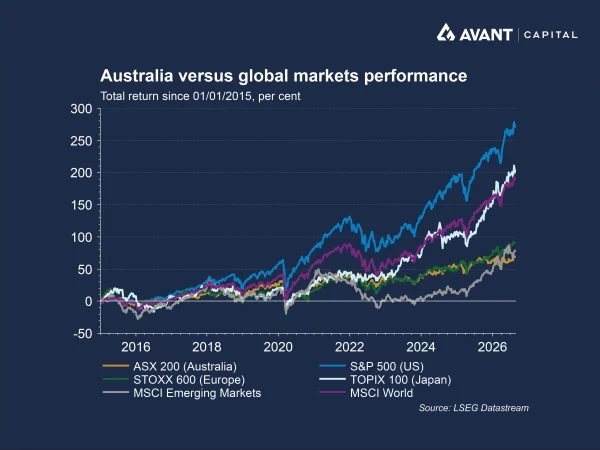
That income has supported retirees and other investors who depend on regular cash flows. Yet an increasingly defensive allocation of capital could leave Australian portfolios concentrated in banks, miners, utilities and other mature businesses while reducing funding for younger companies with longer investment horizons. Existing superannuation performance rules may amplify the effect by encouraging large funds to remain close to index benchmarks and the market’s largest companies6.
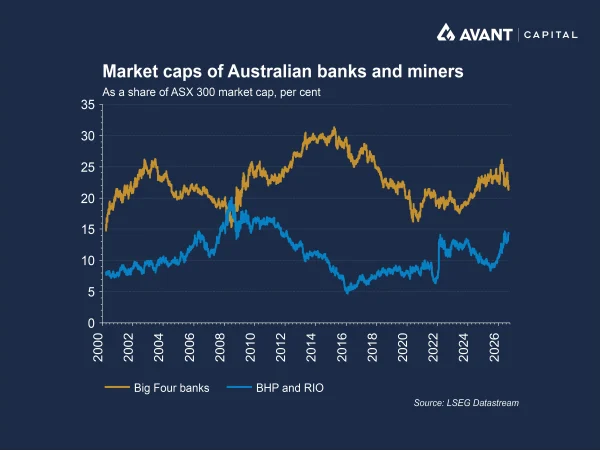
The risk is not simply that Australian shares continue to trail faster-growing overseas markets. A less dynamic exchange may experience fewer initial public offerings, lower liquidity outside the largest companies and a thinner pool of capital for businesses attempting to scale. The tax changes may also strengthen the “lock-in” effect, under which investors avoid selling appreciated assets and reallocating funds to newer opportunities because doing so crystallises a tax liability.
What could this mean for productivity and living standards?
Australia can ill afford another disincentive to invest. Productivity declined by 0.7% in 2024, placing Australia 29th among 39 advanced economies, while average productivity growth over the previous five years was only 0.1% compared with around 1.5% during the 2000s7. Research and development investment was equivalent to 1.1% of GDP, only one-third of the United States’ level.
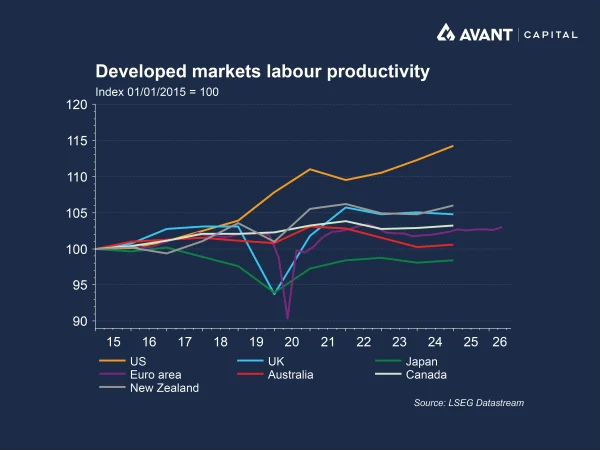
Business investment is one of the principal routes through which workers gain better tools, technology and processes. If more profits are distributed and fewer marginal projects proceed because their required pre-tax return has risen, investment in these productivity-enhancing assets may slow. That would constrain wages and living standards while lowering the economy’s non-inflationary growth rate.
Does the dividend shift increase the danger of stagflation?
The immediate macroeconomic setting makes this allocation problem more serious. Stagflation describes the uncomfortable combination of weak economic growth and persistently high inflation. Australia’s June-quarter GDP grew 0.4% and 2.1% over the year, below the long-run rate of about 3%, while productivity fell 0.2% over the year8.
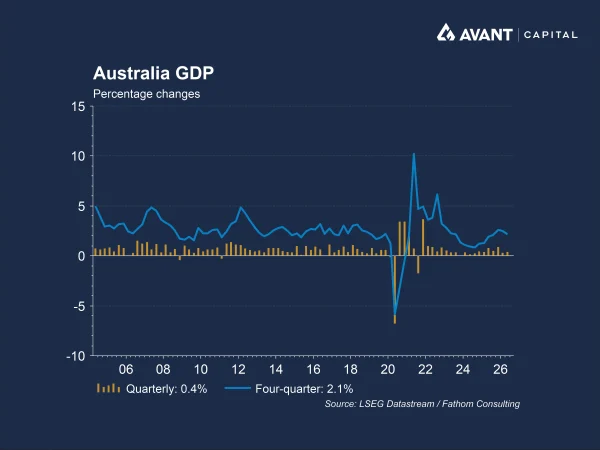
At the same time, domestic labour and dwelling costs have become important inflation drivers, while the Iran conflict has pushed oil and broader energy costs higher. Trimmed mean inflation was 3.6% in July, above the Reserve Bank’s target, and financial markets are pricing at least one further rate rise during 20269.
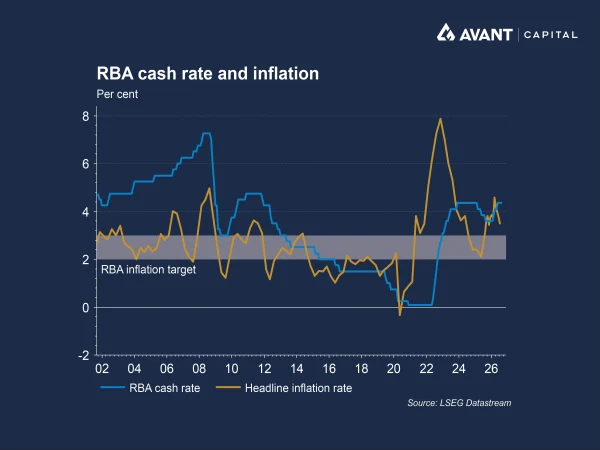
Higher rates, weak corporate confidence and falling house prices could reinforce one another. Housing affects activity through construction, transaction volumes and the wealth effect, whereby households tend to spend less when the value of their assets declines. If companies simultaneously respond to poor demand, expensive capital and investor pressure by paying larger dividends rather than investing, the economy’s short-term slowdown could become a longer-term productivity problem.
Australia’s dividend culture has delivered valuable income and should not be treated as a flaw in itself. The risk for investors is that an incentive structure favouring immediate payouts over productive reinvestment could weaken companies’ capacity to generate future earnings growth. Over time, that could leave the ASX more concentrated in mature, slower-growing businesses and increasingly dependent on dividends to support total returns. Today’s dividend windfall may therefore come at the cost of weaker capital growth and a sharemarket that continues to lag faster-growing overseas peers.
References
- The Australian Financial Review, “Dividend obsession turning the ASX into a high-yield retirement home,” 1 September 2026
- The Australian Financial Review, “Dividend dependent: Profit season exposes ASX’s missing animal spirits,” 16 August 2026
- The Australian Financial Review, “ASX investors ‘overly optimistic’ as analysts slash profit forecasts,” 31 August 2026
- The Australian Financial Review, “The subtext of Chalmers’ budget? Cash out, don’t reinvest,” 28 May 2026
- The Australian Financial Review, “CGT change will increase business investment costs: RBA analysis,” 18 August 2026
- The Australian Financial Review, “Two charts, one crisis: Australia’s top-heavy sharemarket trap exposed,” 16 June 2026
- The Australian Financial Review, “Australia falls behind New Zealand on productivity ranking,” 1 July 2026
- The Australian Financial Review, “The great Australian quagmire will get only deeper from here,” 3 September 2026
- The Australian Financial Review, “RBA shows labour costs are driving inflation, not just oil prices,” 30 August 2026