
Australia’s labour market has long been an important source of resilience for the economy. Even as households absorbed higher living costs and rising mortgage repayments, relatively low unemployment helped support incomes and consumer spending. The latest figures, however, suggest that this resilience may be beginning to weaken.
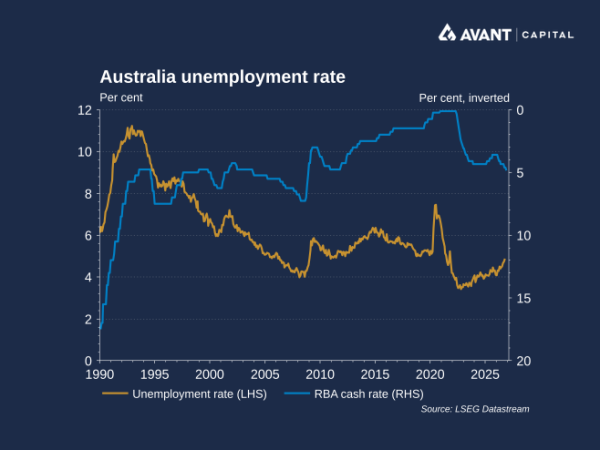
The unemployment rate rose from 4.7% to a five-year high of 4.9% in October, after employment fell by around 43,500 people1. While unemployment remains relatively low by historical standards, it has increased from 4.1% at the beginning of the year and reached 4.9% earlier than the Reserve Bank of Australia had anticipated2.
What do the latest figures tell us?
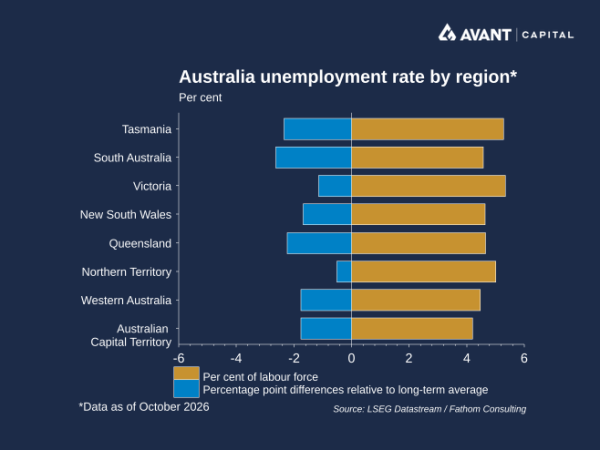
A single month’s employment figures can be volatile, but the broader direction is becoming harder to ignore. The number of unemployed Australians has increased by 14.5% since the beginning of 2026, while the number of people employed has risen by only 0.6%. Youth unemployment has also climbed to 11.3%, its highest level since October 2021, while unemployment in Victoria and Tasmania has reached 5.4%.
The rise in unemployment has been accompanied by a pronounced increase in retrenchments. Approximately 65,700 people were made redundant in September, lifting the three-month total to 174,100, the highest since November 2020. More than 7,000 positions have also been affected by prominent redundancy and outsourcing announcements since the beginning of October.
Changes to the Australian Bureau of Statistics’ collection methods mean the retrenchment figures should be interpreted carefully. Nevertheless, the increase is consistent with developments being reported across corporate Australia and with other signs that labour demand is cooling.
Why are businesses cutting jobs?
There is no single explanation for the recent wave of job cuts. Instead, a slowing economy, pressure on company earnings, technological change and offshoring are reinforcing one another.
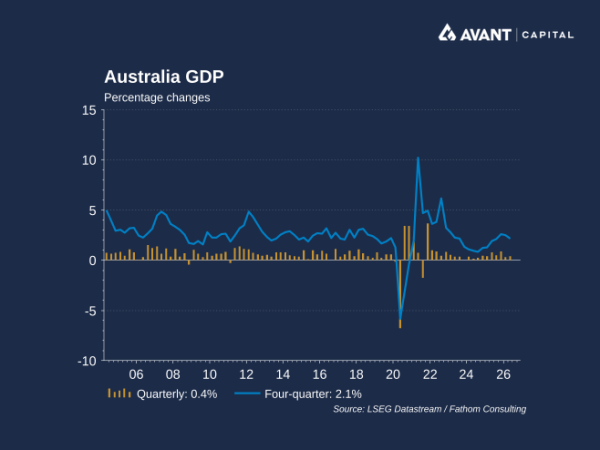
Higher interest rates are weighing on household spending, housing activity and business confidence. As revenue growth becomes harder to achieve, companies are looking more closely at their costs, and employment is often one of their largest expenses. The RBA expects economic growth of only around 1 to 1.5% a year, well below the 2 to 3% environment to which many established businesses had become accustomed3.
Corporate restructuring has consequently spread across a range of industries. National Australia Bank announced plans to cut 2,500 jobs4, Qantas is reducing around 850 head-office roles5 and Bunnings is cutting 350 technology positions6. David Jones expects around 1,500 redundancies as it prepares to close 19 of its 38 stores7, while General Pants entered administration with 475 employees across the business8.
How are technology and offshoring changing employment?
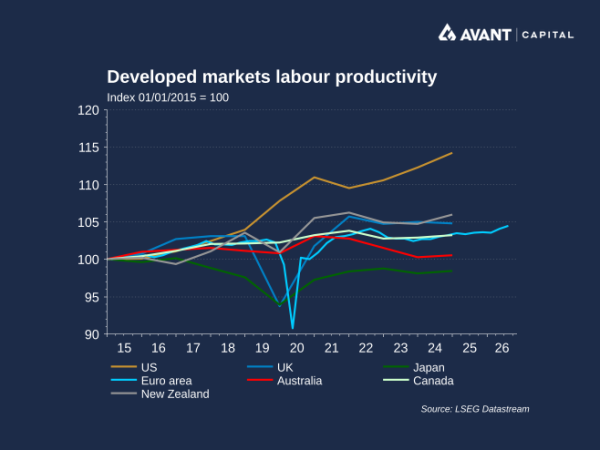
Some job losses reflect a conventional economic slowdown, but others point to a structural change in the Australian workforce. Large employers are increasingly shifting technology and corporate support functions offshore while investing in artificial intelligence and automation.
Bunnings is transferring technology work to Tata Consultancy Services teams in India and the Philippines. Qantas has entered a broader arrangement with Accenture involving finance, procurement, human resources and marketing functions, while Coles, Woolworths and the major banks have also expanded or developed offshore operations.
In many cases, the emerging model is to move work to a lower-cost location before progressively automating parts of it. That makes the current adjustment different from earlier downturns. Job losses are not confined to industries experiencing weak demand, but are also affecting software engineers, project managers, finance teams and other white-collar occupations.
Artificial intelligence is unlikely to eliminate the need for skilled employees altogether. It is more likely to change the mix of roles, reducing demand for some routine and entry-level tasks while creating opportunities in areas such as data, cybersecurity, engineering and the implementation of AI systems. The transition, however, may be uneven, particularly if new positions emerge more slowly than existing ones disappear.
Why is retail under particular pressure?
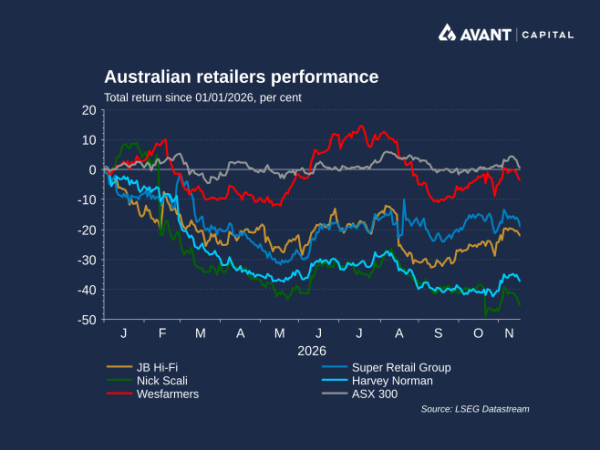
Retail is experiencing the combined effects of higher interest rates, falling housing activity, subdued sentiment and changing consumer behaviour. The slowdown has been especially visible among businesses linked to housing and discretionary spending.
Capital-city dwelling prices have fallen, while housing transactions declined by 17.4% over the three months to September9. Lower property turnover affects demand for furniture, electronics and household goods, while falling home values can also make consumers feel less wealthy and more cautious.
Trading updates have reflected this pressure. Bunnings reported moderating sales growth, JB Hi-Fi’s Australian comparable sales declined by 1.4% in the September quarter, and Nick Scali reported weaker traffic and earnings. The difficulties confronting David Jones and General Pants also illustrate how an economic slowdown can expose businesses already dealing with debt, high fixed costs or structural competition from online retailers.
What does this mean for interest rates?
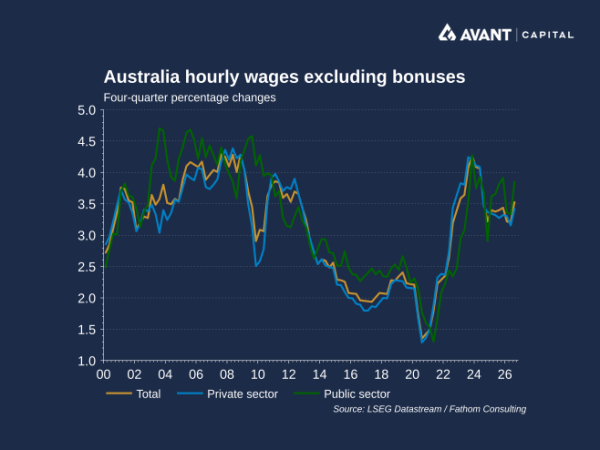
A weaker labour market complicates the RBA’s task. Inflation remains elevated and annual wage growth accelerated to 3.5% in the September quarter, with public-sector wages increasing by 3.9%10. However, rising unemployment indicates that restrictive monetary policy is increasingly affecting demand.
Financial markets responded quickly to the October employment report. Expectations for another interest-rate increase were largely removed, while traders began pricing the possibility of a rate cut during 202711. The Australian dollar also fell and government bond yields declined as markets reassessed the economic outlook.
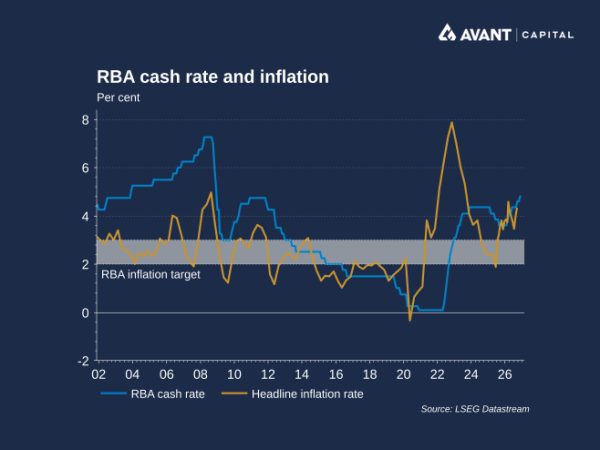
The RBA is unlikely to respond to one labour-force report alone, particularly while inflation remains above target. However, if unemployment continues to rise and household spending weakens further, the balance of risks could shift from controlling inflation towards preventing an unnecessarily severe downturn.
Where could the economy go from here?
Australia is not yet in a technical recession, which is commonly defined as two consecutive quarters of contracting economic output. Even so, economic data is backward-looking, and recently announced redundancies may not yet be fully reflected in the official figures.
Rising unemployment could also increase mortgage arrears as affected households struggle to meet repayments. While mortgage stress remains low by historical standards, job losses could lead to more missed payments and forced property sales, particularly if house prices continue to fall.
The labour market is therefore likely to be one of the clearest indicators of whether Australia achieves a gradual slowdown or experiences something sharper. For households, the key issue is not simply whether the economy meets the technical definition of recession. Employment security, wages and confidence have a more immediate influence on how people perceive economic conditions.
The recent figures do not establish that a recession is inevitable. They do, however, suggest that the margin for error is narrowing. Australia’s labour market remains in reasonable condition by historical standards, but its direction has changed, and the growing breadth of job cuts shows that the economic slowdown is becoming increasingly tangible.
References
- The Australian Financial Review, “Jobless rate jumps to five-year high as downturn fears grow,” 19 November 2026
- The Australian Financial Review, “Rising unemployment will make both RBA and Labor nervous,” 19 November 2026
- The Australian Financial Review, “Inside corporate Australia’s new cost-cutting playbook,” 19 November 2026
- The Australian Financial Review, “The two forces behind NAB’s job cuts should scare every Australian,” 20 October 2026
- The Australian Financial Review, “Qantas just showed you how AI will kill white-collar jobs,” 10 November 2026
- The Australian Financial Review, “Bunnings cuts 350 tech jobs in offshoring push,” 17 November 2026
- The Australian Financial Review, “David Jones to slash 1500 jobs by year-end as store closures loom,” 18 November 2026
- The Australian Financial Review, “General Pants blames online retailing giants for collapse,” 19 November 2026
- The Australian Financial Review, “Housing correction is smashing Bunnings, JB Hi-Fi. The pain will spread,” 29 October 2026
- The Australian Financial Review, “Public sector pay deals fuel fastest wage growth since 2023,” 18 November 2026
- The Australian Financial Review, “‘RBA will not hike again’: Traders eye early rate cuts on jobs crunch,” 19 November 2026