Why did the Federal Reserve raise rates in September?
The Federal Reserve’s September meeting marked an important change in direction for US monetary policy. Policymakers unanimously raised the federal funds rate by 0.25 percentage points to a range of 3.75% to 4%, delivering the first increase since 20231. Most officials also projected at least one further rise before the end of 2026, signalling that September’s decision may be the beginning of a renewed tightening phase rather than an isolated adjustment.
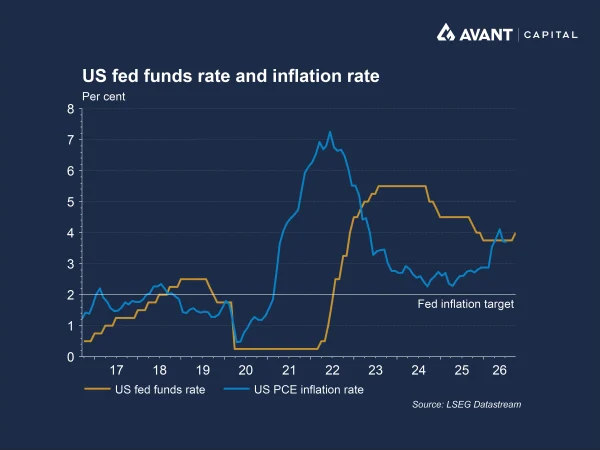
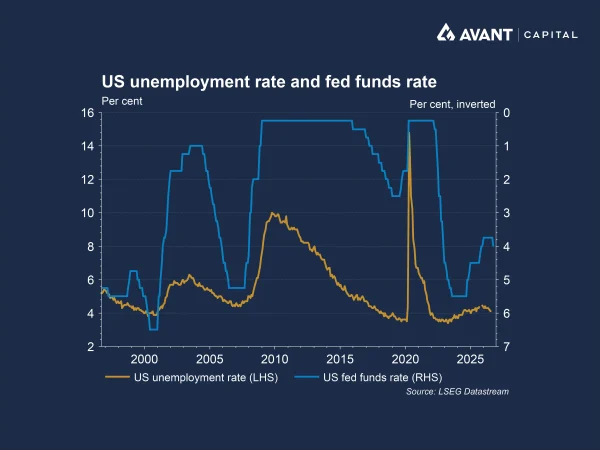
The increase reflected a combination of stubborn inflation and continued economic resilience. The Fed’s preferred personal consumption expenditures measure was running at 3.7%, well above its 2% target, while inflation has remained above that objective for more than five years. Meanwhile, employment, business investment and household demand have proved stronger than officials expected. This reduced the risk that a modest rate rise would immediately destabilise the labour market and gave the central bank greater scope to concentrate on price stability.
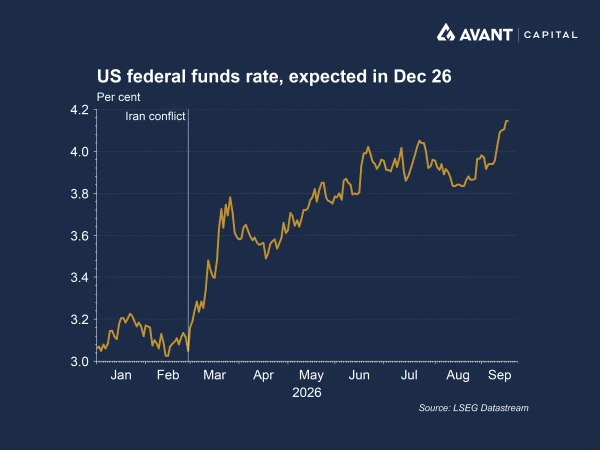
The decision was also about institutional credibility. Before the meeting, markets had assigned roughly a 90% probability to a quarter-point rise2. After repeatedly warning that inflation was not improving quickly enough, Chair Kevin Warsh risked weakening confidence in the Fed if those warnings were not followed by action. The unanimous vote therefore carried an additional message: policymakers were prepared to resist both persistent inflation and political pressure for substantially lower borrowing costs.
How has the Iran conflict altered the inflation outlook?
The Iran conflict has disrupted what had appeared to be a gradual disinflationary process. Higher crude oil prices are only the most visible part of the shock. Record US diesel prices, refining bottlenecks and rising freight costs are feeding through supply chains, increasing expenses across shipping, aviation, food production and manufacturing. The pressure in refined fuels has been particularly severe: diesel prices have reflected conditions more consistent with crude oil near $US200 a barrel, even as headline crude prices remained closer to $US1003.
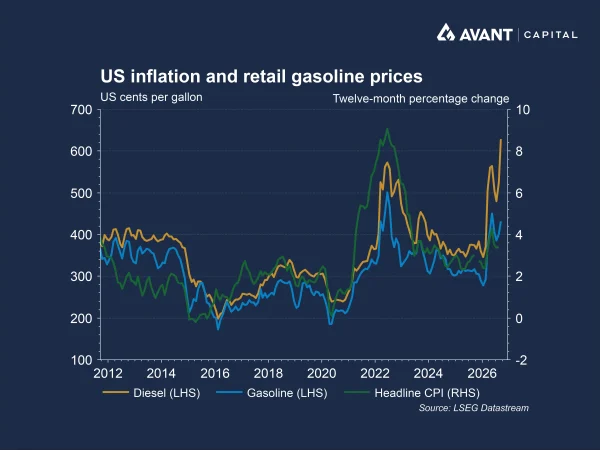
This creates a difficult policy problem. Higher interest rates cannot produce more oil, reopen transport routes or add refining capacity. However, if the initial energy shock begins influencing wages, services and inflation expectations, the Fed may feel compelled to restrain demand elsewhere in the economy. The danger is that monetary policy ends up weakening interest-sensitive activity while doing little to repair the original disruption.
The persistence of the shock may matter more than the peak oil price. Businesses can sometimes absorb a brief rise in energy costs, but a prolonged increase is more likely to be passed on to customers. That prospect has made developments in Iran, regional energy infrastructure and global refining markets important inputs into the outlook for central banks well beyond the United States.
Why are global bond yields moving higher?
The bond sell-off is global rather than solely American. The 10-year US Treasury yield briefly moved above 5%, reaching its highest level since 20074. Japan’s 10-year yield climbed as high as 3.04%, its highest in 30 years, while the UK 10-year gilt yield briefly reached 5.44%. Because government bond yields influence mortgages, corporate loans and asset valuations, the rise represents a broad tightening in financial conditions even before further central-bank action occurs.
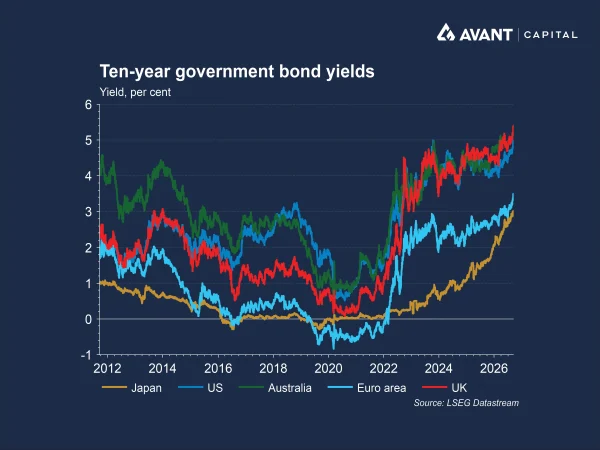
Several forces are acting together. The energy shock has raised inflation expectations, resilient growth has reduced expectations of near-term rate cuts, and large government borrowing requirements have increased the supply of bonds. At the same time, artificial-intelligence infrastructure is creating intense competition for capital as technology companies and data-centre developers raise funding. Investors are consequently demanding greater compensation to hold long-dated debt.
The strain is already passing into the real economy. The US 30-year mortgage rate approached 7%, up from about 6% in February.
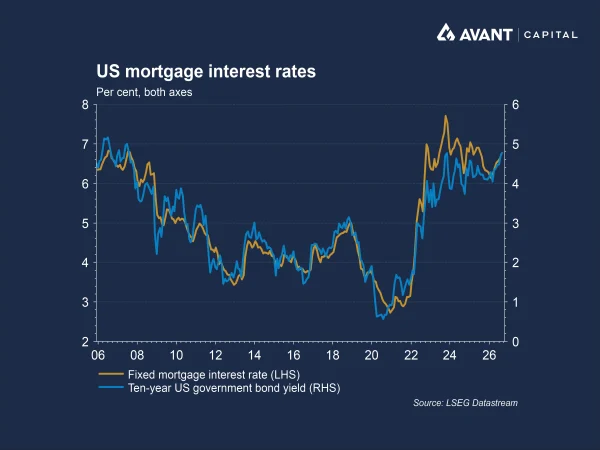
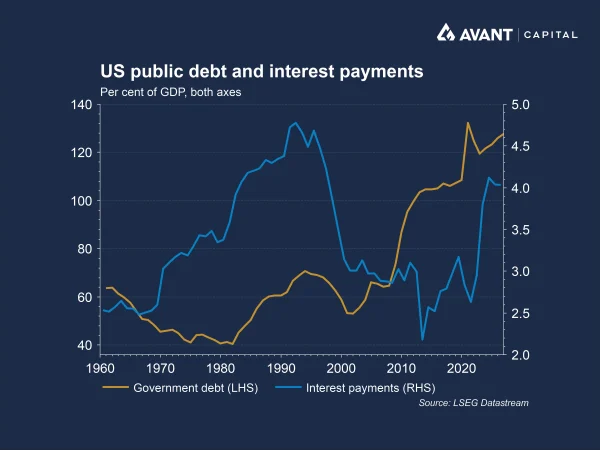
Higher benchmark yields also increase refinancing costs for businesses and raise government debt-servicing expenses. Across OECD countries, annual debt-servicing costs have risen above $US2 trillion, equivalent to approximately 3% of combined GDP.
Can Warsh guide markets without forward guidance?
Kevin Warsh has long been sceptical of detailed forward guidance, arguing that continually narrating the policy outlook can constrain a central bank’s flexibility. His early press conferences offered limited guidance about how he interpreted economic data or what might trigger a change in rates. That approach left investors to infer his reaction function and contributed to unusually broad interpretations of whether he was inclined to delay tightening or move decisively against inflation.
September illustrated the risks of communicating less while still using consequential language. Kevin Warsh said the Fed had removed a “dose of accommodation”, wording that appeared to suggest policy had previously been supporting growth. He subsequently resisted that interpretation and dismissed the practical relevance of estimates of the neutral interest rate. Nevertheless, Treasury yields rose and equities weakened as investors reconsidered how far rates might ultimately have to climb.
His communication strategy is therefore not simply a stylistic matter. Less forward guidance can preserve flexibility, but it can also increase market volatility when individual phrases carry more weight. The challenge will be to avoid binding the Fed to a predetermined path while still explaining its policy framework clearly enough to anchor expectations.
What could determine the next move?
The next phase will depend on whether energy pressures fade, whether inflation broadens and whether economic growth remains resilient. A resolution of the Iran conflict could ease oil, diesel and freight costs, potentially reducing pressure on global yields. Continued disruption, however, would strengthen the argument for additional tightening, particularly if businesses pass higher costs through to consumers.
For households and companies, September’s decision matters less as a single quarter-point increase than as evidence that the anticipated era of steady rate reductions has been interrupted. The central question is now whether the Fed can restore confidence in its inflation target without unnecessarily damaging growth. Its success may depend as much on events in energy markets and geopolitics as on decisions made in Washington.
References
- Financial Times, “Federal Reserve defies Donald Trump with first rate rise since 2023,” 17 September 2026
- The Wall Street Journal, “U.S. markets sell off after Fed’s Warsh says inflation is still ‘too high,’” 16 September 2026
- The Wall Street Journal, “Fed delivers first rate hike in years with unanimous vote,” 16 September 2026
- Financial Times, “Ten-year Treasury yield hits highest level since 2007,” 15 September 2026