Why are Chinese AI developments becoming increasingly important for investors?
For much of the last two years, the dominant market narrative has been that the United States would remain the clear leader in artificial intelligence, with American companies capturing the bulk of the economic benefits from the technology. That assumption has helped fuel extraordinary gains in US technology shares, particularly among AI-linked companies such as Nvidia, Broadcom, Micron Technology and Alphabet. However, recent developments from Chinese AI firms suggest that investors may need to consider a more competitive future.
The latest example is Kimi K3, a new model developed by Beijing-based Moonshot AI. According to benchmark results cited by multiple industry sources, Kimi K3 is approaching the performance of leading US frontier models in several coding and AI agent tasks while being released as an open-weight model that can be downloaded and modified by users1. The model contains 2.8 trillion parameters, making it one of the largest open-weight AI models released to date2. The number of parameters refers to the size of the model’s neural network, with a higher count generally leading to greater capabilities.
While Kimi K3 may not yet surpass the very best proprietary US models across all tasks, its release reinforces a broader trend: China’s leading AI developers appear to be closing the gap with US competitors faster than many investors expected. Several commentators now suggest the lead held by US frontier labs may have narrowed to only six to nine months.
What lessons can investors draw from the DeepSeek shock?
Investors have seen this movie before. In January 2025, the release of DeepSeek’s highly capable and cost-efficient model sparked a sharp sell-off in AI-related stocks. The market suddenly questioned whether enormous AI infrastructure spending by US technology firms would ultimately generate the returns investors had been assuming.
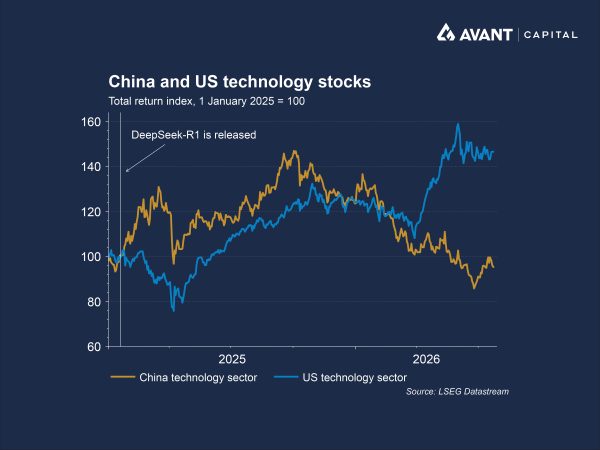
While markets eventually recovered, the DeepSeek episode highlighted a key risk. If Chinese firms can produce increasingly capable models at significantly lower costs, assumptions about the future economics of AI could be challenged.
The recent reaction to Kimi K3 suggests those concerns have not disappeared. Following its release, major semiconductor stocks came under pressure, with investors questioning whether future demand for cutting-edge hardware could be lower than expected if more efficient models reduce computing requirements. The Philadelphia Semiconductor Index fell into bear market territory during the broader AI-driven sell-off, while many analysts described the event as “DeepSeek 2.0”.
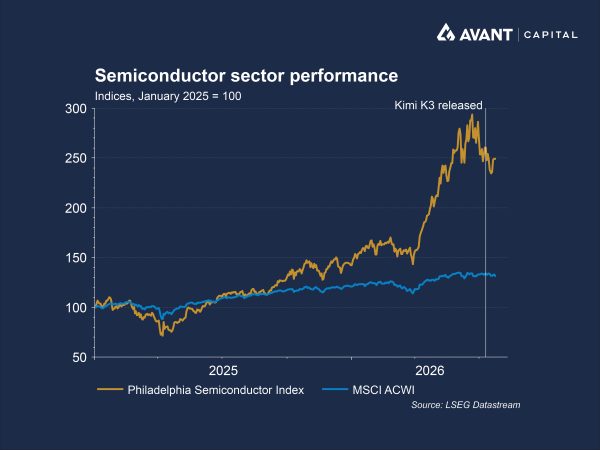
Importantly, this is not necessarily a prediction that demand for AI infrastructure will collapse. Rather, it highlights how sensitive current valuations remain to changes in expectations around future AI economics.
How could lower-cost Chinese models pressure US AI companies?
One of the most significant risks facing US AI companies is the possibility that frontier AI models become increasingly commoditised.
Chinese developers such as Moonshot, DeepSeek, Alibaba and Z.AI have focused heavily on open-weight and lower-cost models. These systems often allow enterprises to download, customise and run models themselves rather than paying recurring fees to leading proprietary AI providers.
Several industry sources note that companies are already experimenting with switching some workloads from expensive proprietary US models to lower-cost Chinese alternatives3. Even if the Chinese models remain slightly inferior at the cutting edge, they may be more than sufficient for many commercial use cases. This raises an uncomfortable question for firms such as OpenAI and Anthropic. If model performance continues to converge, will customers continue paying premium prices?
The risks are not limited to AI model developers. Competitive pressure could compress margins across the AI ecosystem, potentially reducing the profitability assumptions embedded in many AI-related valuations.
Why does this matter for hyperscalers and capital expenditure?
The discussion becomes even more important when considering the enormous investments being made by hyperscalers.
Hyperscalers are the largest cloud computing and data centre operators in the world, including Microsoft, Amazon, Alphabet (Google), Meta and Oracle. These companies are investing hundreds of billions of dollars into AI infrastructure, ranging from advanced data centres and networking equipment to specialised AI chips.
Market expectations assume these investments will eventually generate substantial returns through AI services, cloud computing revenue and productivity gains. Indeed, Wall Street expects the largest AI spenders to collectively invest around $US1 trillion per year between 2026 and 20284. The challenge is simple: the bigger the capital expenditure, the bigger the required future cash flows.
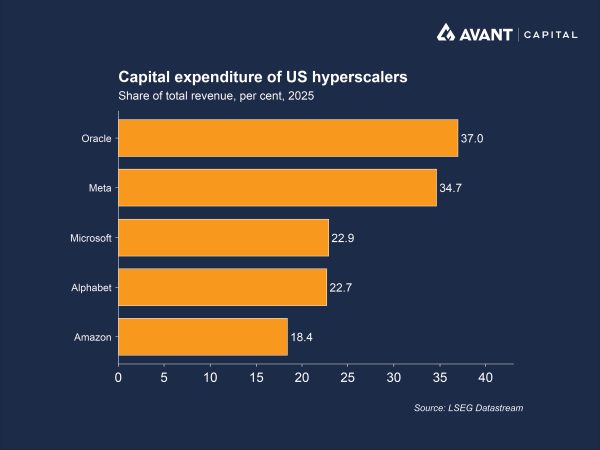
If Chinese competition drives down pricing, speeds up commoditisation or reduces barriers to entry, generating attractive returns on these investments may become more difficult. This does not mean AI spending has been a mistake. However, it may mean the pathway from spending to profits is less certain than current market valuations imply.
A growing number of enterprises are also adopting open-weight models precisely because they can reduce costs. Some reports suggest usage of open models among large organisations has been growing far faster than proprietary alternatives.
Could the risks be larger because of US market concentration?
Another consideration is market concentration. Today, a relatively small group of AI-linked technology companies accounts for a large share of major US indices such as the S&P 500. Much of the market’s earnings growth expectations are increasingly tied to the success of the AI investment cycle. As a result, even modest changes in assumptions regarding AI profitability can have an outsized impact on broader equity markets.
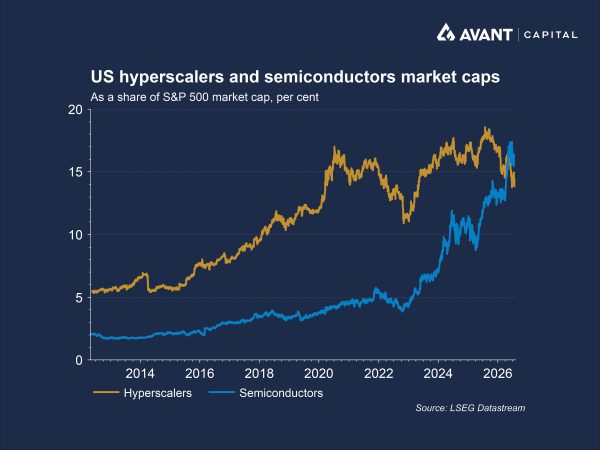
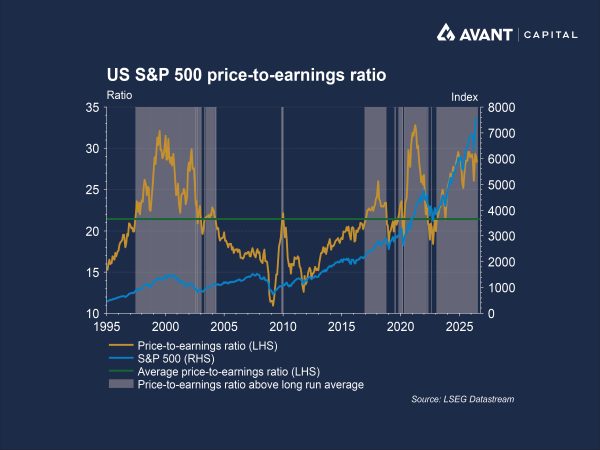
If investors become less confident that AI leaders can earn attractive returns on their massive investments, the effect may extend well beyond AI stocks themselves. This is particularly true because current valuations already assume strong growth, strong margins and successful commercialisation of AI technologies over many years.
What is the bigger picture for investors?
None of this means China will inevitably become the global AI leader. US companies continue to lead in many important areas, including advanced semiconductor design, computing infrastructure, frontier model research and commercial deployment.
However, recent developments from DeepSeek, Moonshot’s Kimi K3, Alibaba’s Qwen models and other Chinese firms suggest the competitive landscape is evolving more rapidly than many market participants expected.
The key point is not that US AI leaders are destined to lose. Rather, it is that the risks associated with rising Chinese competition may not be fully reflected in current valuations. In a market where AI-related companies represent a significant share of overall index performance and are spending unprecedented amounts of capital, that is a factor investors cannot afford to ignore.
References
- The Wall Street Journal, “China’s Moonshot AI releases model to challenge top U.S. systems,” 17 July 2026
- Financial Times, “Chinese AI start-up Moonshot launches model challenging Anthropic’s lead,” 17 July 2026
- Financial Times, “Companies turn to Chinese AI models to cut costs,” 13 July 2026
- Financial Times, “How to be a bull on the S&P 500,” 23 July 2026