
Why has diesel become more important than crude oil?
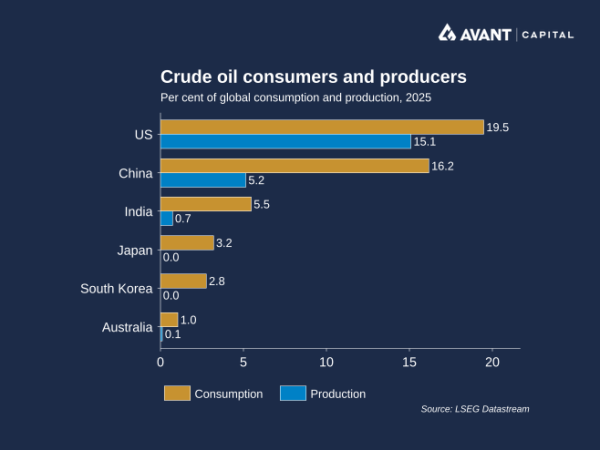
The global economy has absorbed the Iran war’s initial energy shock better than many expected. Alternative export routes, higher production outside the Middle East, lower demand and emergency inventory releases have helped replace much of the crude oil lost through the Strait of Hormuz. Yet this apparent resilience conceals a more acute problem: the world does not consume crude oil directly. It depends on refineries to turn crude into diesel, petrol, jet fuel and other products.
Damage to Gulf refining capacity, disruption to shipping and the difficulty of substituting between different crude grades have created a shortage of refined products, particularly diesel. Diesel is indispensable to trucking, agriculture, construction, mining and industrial production. That makes its price an unusually powerful transmission mechanism between geopolitical disruption and the broader economy.
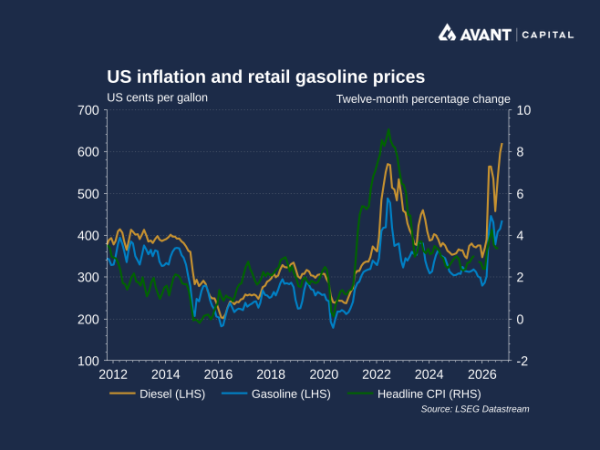
The imbalance is evident in prices. European diesel futures recently jumped as much as 8% to $US1,435.25 a tonne after the International Energy Agency clarified that a proposed 100 million-barrel release would come from the 400 million barrels already pledged in March, rather than representing additional supply1. US diesel, meanwhile, reached a record $US6.50 a gallon in September2.
How does expensive diesel feed into inflation?
Diesel’s economic importance lies in the breadth of its use. Higher fuel costs raise the price of moving food, consumer goods and industrial inputs. Farmers face higher costs for machinery and transporting produce, while logistics companies must either absorb the increase or pass it through to customers. Those pressures can eventually appear in supermarket prices, construction costs and the price of manufactured goods.
This creates a more persistent inflation risk than the initial rise in headline energy prices might suggest. If businesses begin routinely incorporating elevated freight and production expenses into their pricing, the shock can spread into core inflation. Workers may also seek higher wages to compensate for cost-of-living pressures, increasing the danger that a temporary supply disruption becomes embedded in the inflation process.
Australia’s reliance on imported oil and diesel, combined with its high use of diesel across freight, agriculture, mining and construction, leaves the economy particularly exposed to prolonged global supply disruptions. Higher transport and operating expenses can spread through supply chains, adding to the cost of goods and services and reinforcing broader inflationary pressures. This is particularly significant when domestically generated inflation is already elevated, because an external energy shock can reinforce existing price pressures rather than merely producing a temporary increase in fuel costs.
Why are bond yields responding so sharply?
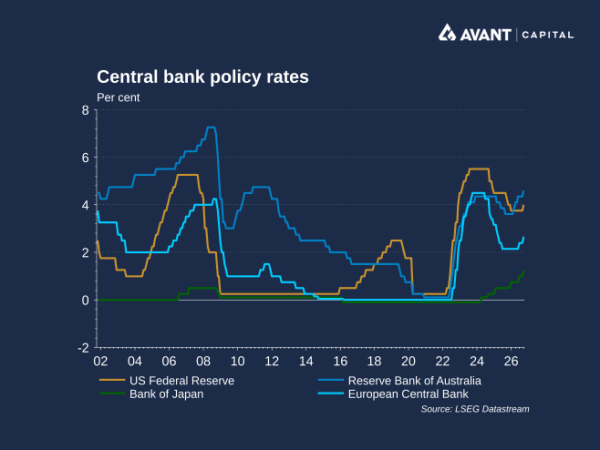
An energy shock confronts central banks with an uncomfortable combination of weaker activity and higher inflation. Policymakers can do little to manufacture diesel or reopen shipping routes, but they may still need to maintain higher interest rates to prevent the initial price shock from altering inflation expectations.
That prospect is being reflected in government bond markets. The median increase in 10-year sovereign yields across G7 countries during 2026 has been approximately one percentage point3. In the US, the 10-year Treasury yield rose by more than half a percentage point during September to 5.3%, its highest level since 2007 and close to levels last experienced in 20024.
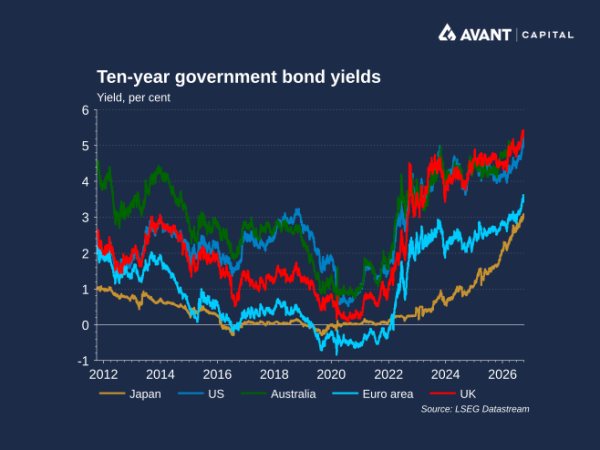
Energy is not the only explanation. Large fiscal deficits, heavy government borrowing, competition for capital and strong investment in artificial-intelligence infrastructure are also exerting upward pressure. Nevertheless, the close relationship between oil prices and bond yields indicates that the Iran war has materially changed expectations for inflation and monetary policy.
There is also a danger that the bond adjustment becomes self-reinforcing. Rising yields can force leveraged funds and holders of mortgage-backed securities to reduce exposure, producing further selling. If traditional buyers remain reluctant to enter the market, an inflation-driven repricing can develop into a broader liquidity and financial-stability event.
Why have equity markets remained resilient?
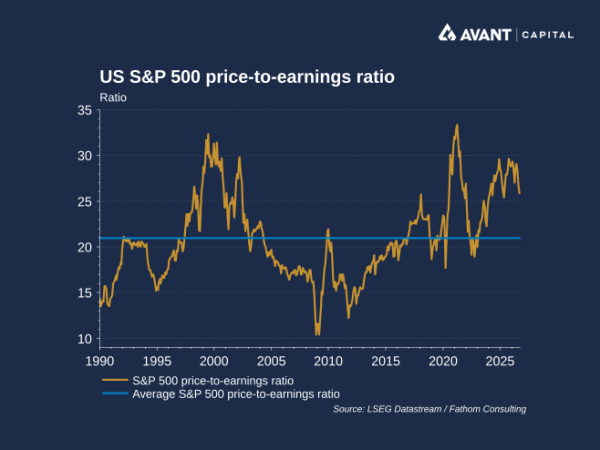
Equities have so far received considerable protection from strong earnings expectations, particularly among large technology companies. The S&P 500 recently reached a record high despite elevated oil prices and a severe government bond sell-off. Analysts expect third-quarter earnings to rise by 29.5% from a year earlier, with AI infrastructure companies contributing disproportionately to that growth5.
However, the headline index disguises considerable weakness beneath the surface. Only around one-third of S&P 500 constituents rallied following the market’s September low, while the equal-weighted index remained more than 5% below its record.
Elevated equity valuations add to the risk created by this market concentration. Higher bond yields reduce the present value of future earnings and raise financing costs, leaving highly valued companies particularly sensitive to any disappointment in earnings. If momentum among the largest technology companies weakens while fuel costs remain elevated, markets could face both lower earnings expectations and valuation compression.
What happens if inventories continue falling?
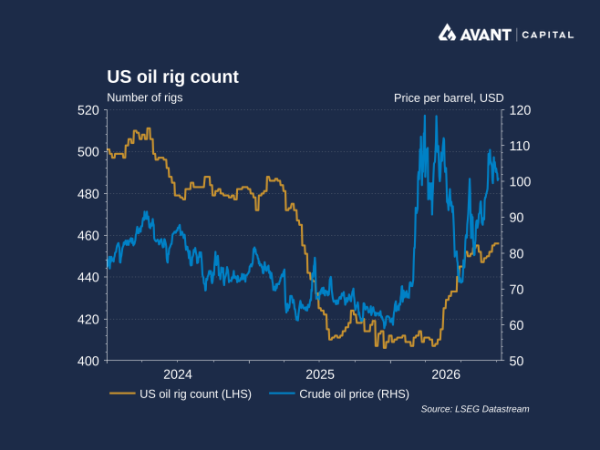
While the US oil rig count has risen slightly, the production response has not been sufficient to offset the continuing reduction in available supply. Inventories have therefore been the principal shock absorber of the crisis, but they cannot provide a permanent substitute for production.
The IEA estimates that observed global oil stocks have fallen by an average of about 2.8 million barrels a day since the war began, including a 3.1 million-barrel-a-day decline in August6. US distillate inventories recently stood 12% below their five-year seasonal average7, while the Strategic Petroleum Reserve had fallen to 283 million barrels, its lowest level since October 19828.
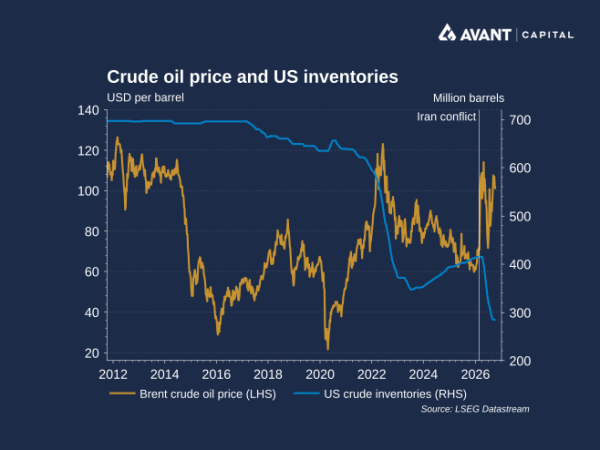
Emergency releases can suppress prices temporarily and prevent physical shortages, but repeated drawdowns reduce the capacity to respond to another disruption. They also risk encouraging markets to focus on the diminishing size of the buffer rather than the immediate volume released.
If the conflict persists, the crucial question will be whether production and refining capacity can recover before inventories become uncomfortably low. Without that recovery, another attack on shipping, refinery outage or disruption to alternative export routes could cause a disproportionately large price reaction. The initial energy shock has been manageable because the world had inventories, adaptable supply chains and spare policy capacity. As those protections are consumed, the next phase may prove considerably harder to contain.
References
- Financial Times, “Diesel price jumps after IEA says no additional fuel will be released,” 8 October 2026
- Financial Times, “US oil industry warns diesel prices will not return to normal for a year,” 1 October 2026
- Financial Times, “Why are bond yields so high?” 6 October 2026
- Financial Times, “US government debt rout triggers ‘vicious loop’ of selling,” 1 October 2026
- Financial Times, “S&P 500 hits record high as AI stocks shrug off bond market slump,” 7 October 2026
- The Wall Street Journal, “US-Iran escalation to delay oil flow recovery into next year, IEA says,” 11 September 2026
- The Wall Street Journal, “US crude oil stockpiles post weekly drop,” 7 October 2026
- The Wall Street Journal, “Oil prices fall as G-7 plans crude, diesel release but Hormuz shipping risks persist,” 5 October 2026