
The US second-quarter earnings season has delivered a remarkably strong set of results so far, confounding concerns about elevated energy prices and slowing economic growth. Despite operating in an environment marked by geopolitical tension, inflation concerns and rising borrowing costs, corporate America has continued to demonstrate impressive resilience.
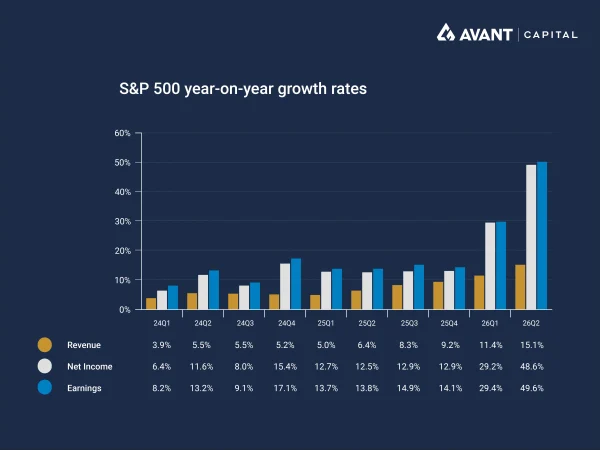
With more than three-quarters of the S&P 500 having reported, earnings growth is tracking close to 50% year-on-year, making it the strongest quarter for profit growth in five years1.
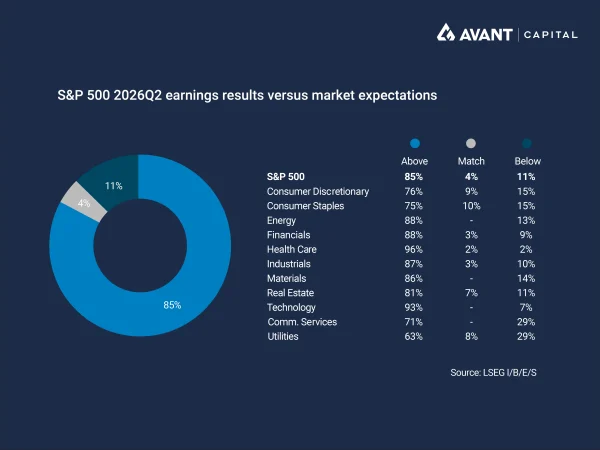
Around 85% of reporting companies have exceeded earnings expectations, well above historical averages, highlighting just how robust corporate profitability remains across much of the US market.
Why have corporate profits been so strong?
The fundamental story behind this earnings season is that the US economy has proven far more resilient than many expected. While GDP growth slowed to an annualised rate of 1.5% in the second quarter, consumer spending remained surprisingly robust, rising at a 2.1% pace despite higher fuel costs and elevated interest rates2.
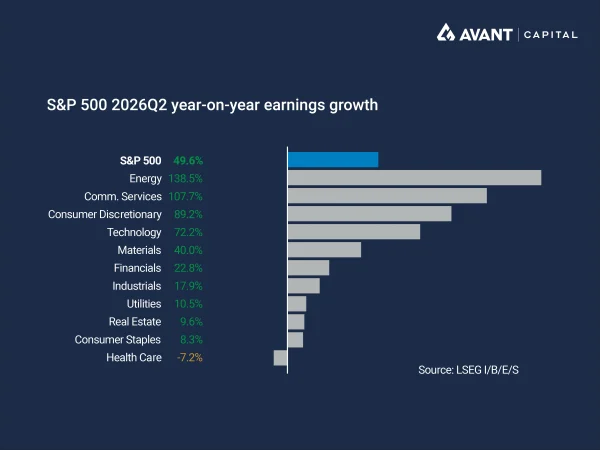
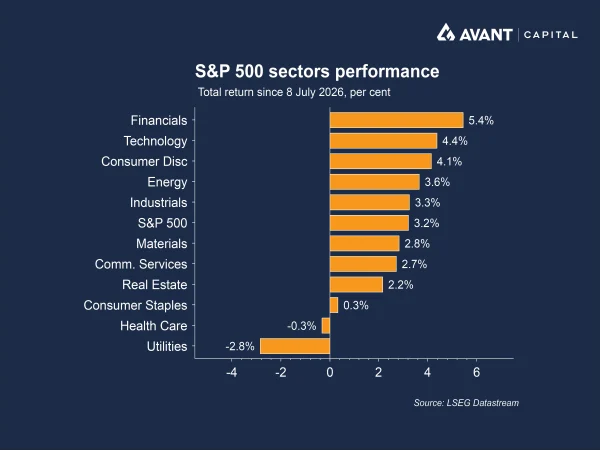
Importantly, profit growth has broadened beyond the largest technology companies. Eight of the S&P 500’s eleven sectors are reporting double-digit earnings growth, reflecting strength across parts of the economy ranging from financials and energy to industrials and consumer discretionary businesses. This broadening of earnings growth is encouraging because it suggests corporate profitability is becoming less reliant on a handful of mega-cap technology companies. Strong consumer spending, higher energy prices and AI-related investment are supporting revenue growth across a wider range of sectors, including financials, industrials and energy.
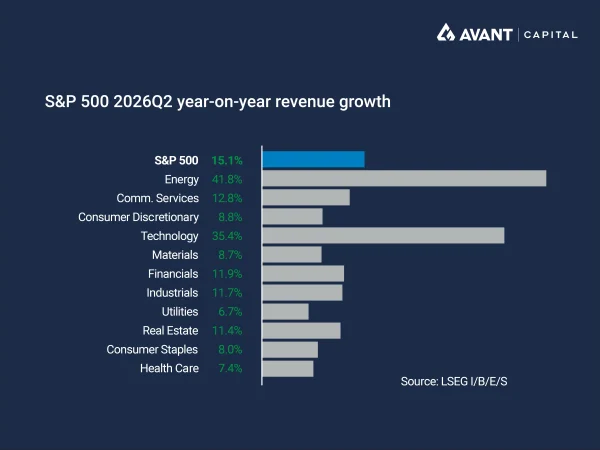
The combination of resilient consumer demand, strong labour markets and ongoing investment in artificial intelligence (AI) infrastructure has created powerful tailwinds for corporate earnings. Even companies facing higher operating costs have generally managed to maintain margins through pricing power, productivity gains or growing demand. As earnings season has progressed, this strength has also contributed to broader market participation, with gains increasingly extending beyond the technology sector into areas such as financials, industrials, energy and consumer discretionary.
How has artificial intelligence become the dominant earnings theme?
The defining theme of this earnings season remains the unprecedented investment wave surrounding artificial intelligence.
The four major hyperscalers, Google, Amazon, Microsoft and Meta, have now collectively invested more than $US1 trillion in capital expenditure since the AI boom began in 20233. This year alone, the group is expected to spend approximately $US745 billion on AI-related infrastructure, including data centres, semiconductors and power generation.
While investors spent much of the year questioning whether such spending could ever generate adequate returns, recent earnings results suggest the first signs of monetisation are emerging.
Cloud computing has emerged as one of the biggest beneficiaries of the artificial intelligence boom. In simple terms, cloud computing allows businesses to rent computing power, data storage and software over the internet rather than owning and maintaining their own technology infrastructure. Google Cloud grew revenue by 82% year-on-year to $US24.8 billion4, Amazon Web Services (AWS) increased 37% to $US42.2 billion5, while Microsoft’s Intelligent Cloud division rose 32% to $US39.3 billion6.
These cloud platforms are increasingly becoming the primary way AI investments are being commercialised. Training and running AI models requires enormous amounts of computing power, much of which is provided through cloud services rather than companies building their own infrastructure. As AI developers, start-ups and large corporations continue adopting AI technologies, demand for cloud capacity has surged, creating a growing revenue stream for the technology giants that have invested heavily in data centres and AI infrastructure.
What have the largest technology companies revealed?
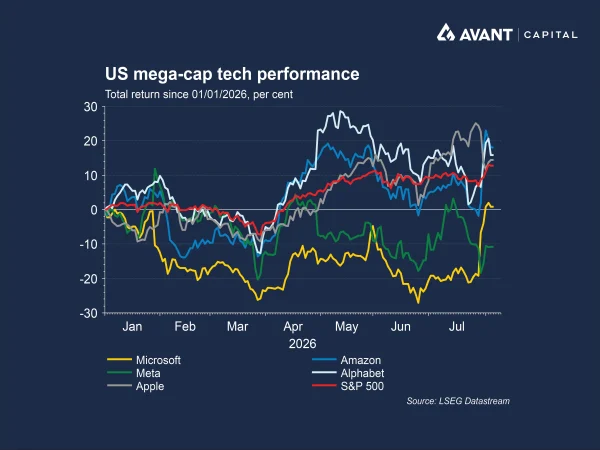
The technology sector has produced some of the most striking earnings announcements of the quarter, though investor reactions have varied significantly.
Microsoft emerged as one of the biggest winners of the season. The company added a record $US450 billion in market value following its results after demonstrating that its AI investments are translating into accelerating cloud revenue growth. The company also signed more than $US130 billion of new data centre leases during the quarter and lifted its future revenue backlog to $US678 billion, providing further evidence that demand for cloud and AI infrastructure remains extremely strong. Amazon similarly impressed investors. AWS delivered its fastest growth rate in more than four years, while management increased planned 2026 capital expenditure to $US220 billion.
Google delivered strong revenue growth and continued momentum in its cloud business, with cloud revenue rising 82% year-on-year and its cloud backlog reaching $US514 billion, highlighting substantial future demand. However, investors were unsettled by the scale of the company’s AI spending. Google reported negative free cash flow of $US5.9 billion in the second quarter, marking the first time since going public more than two decades ago that the company generated negative free cash flow, as investments in data centres and AI infrastructure accelerated.
Meta, meanwhile, highlighted both the promise and risk of AI. Revenue increased 28%, but free cash flow fell 91% year-on-year as infrastructure spending surged7. Investors remain divided on whether Meta’s massive AI spending programme will ultimately generate attractive returns.
Apple offered a different perspective on the AI boom. While rivals are spending hundreds of billions of dollars on data centres and AI infrastructure, Apple has remained relatively disciplined with capital expenditure. However, management warned that the AI investment surge is creating shortages of memory chips and driving up component costs, with memory prices rising by about 300% during the second quarter alone, according to the International Data Corporation8. These pressures are beginning to weigh on margins and future growth expectations, despite otherwise solid earnings results.
What risks are investors still watching closely?
Despite the strong earnings backdrop, several important risks continue to warrant attention.
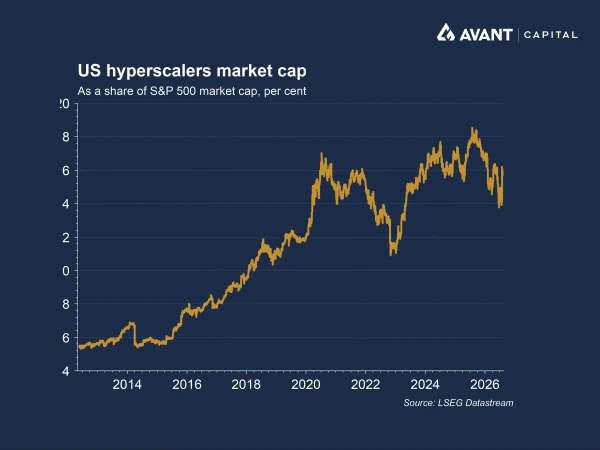
The first is the sheer scale of AI-related spending. Investors are increasingly scrutinising whether technology companies can generate sufficiently attractive returns from the enormous sums being invested in data centres, chips and AI infrastructure. With the major hyperscalers accounting for a significant portion of the S&P 500 and driving much of the market’s earnings and share price performance in recent years, the success or failure of these investments will have important implications for broader equity market returns. Credit markets have already begun signalling some concern, with credit default swap pricing rising for several major technology companies as debt levels increase9.
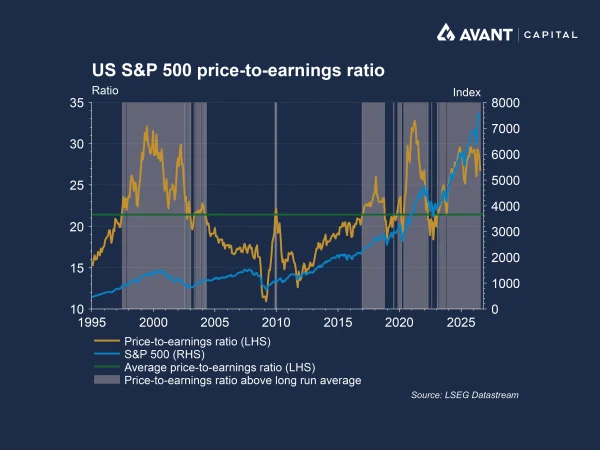
The second risk is the macroeconomic backdrop. US borrowing costs recently reached their highest levels since 2007 as investors worried that higher oil prices and geopolitical tensions could reignite inflation. These concerns are particularly relevant given the S&P 500 is trading at valuations that remain elevated relative to historical averages, leaving less room for disappointment if earnings growth slows or interest rates remain higher for longer. Developments in the Middle East remain another key factor. Ongoing disruptions around the Strait of Hormuz have strained global energy markets, contributed to low US oil inventories and increased uncertainty around future inflation outcomes.
Finally, competition within artificial intelligence continues to intensify. Emerging Chinese AI models are challenging US technology leaders and may place pressure on pricing and profitability over time.
What does this earnings season say about the outlook ahead?
The overarching message from the second-quarter reporting season is that corporate America remains in remarkably good shape. Earnings growth has not only exceeded expectations, but it has also broadened beyond a small group of mega-cap technology companies.
At the same time, markets are becoming more selective. Investors are no longer rewarding AI spending alone. Instead, they are increasingly demanding evidence that vast infrastructure investments are translating into revenue, cash flows and competitive advantages.
So far, companies such as Microsoft, Amazon and Google have largely met that test, while others continue to face tougher questions. As a result, the biggest theme emerging from this earnings season may not be the scale of AI investment itself, but the growing distinction between those companies already monetising the AI revolution and those still asking investors to wait for the payoff.
References
- LSEG I/B/E/S, “S&P 500 earnings scorecard,” 5 August 2026
- Financial Times, “US economy grew less than expected at 1.5% rate in second quarter,” 30 July 2026
- Financial Times, “Big Tech AI spending spree tops $1tn,” 31 July 2026
- Financial Times, “Google burns through $6bn in cash as AI spending climbs again,” 23 July 2026
- Financial Times, “Amazon increases AI infrastructure spending to $220bn this year,” 31 July 2026
- Financial Times, “Microsoft adds $450bn in market cap as results cheer investors,” 30 July 2026
- Financial Times, “Meta shares tumble as Mark Zuckerberg tries to sell his vision for AI ‘agents,’” 30 July 2026
- Financial Times, “Apple shares tumble as AI build-out hits supply chains and growth,” 31 July 2026
- Financial Times, “Big Tech credit risks rise sharply as AI spending soars,” 28 July 2026